 Clara•🕑 October 13, 2026•💬 No comments
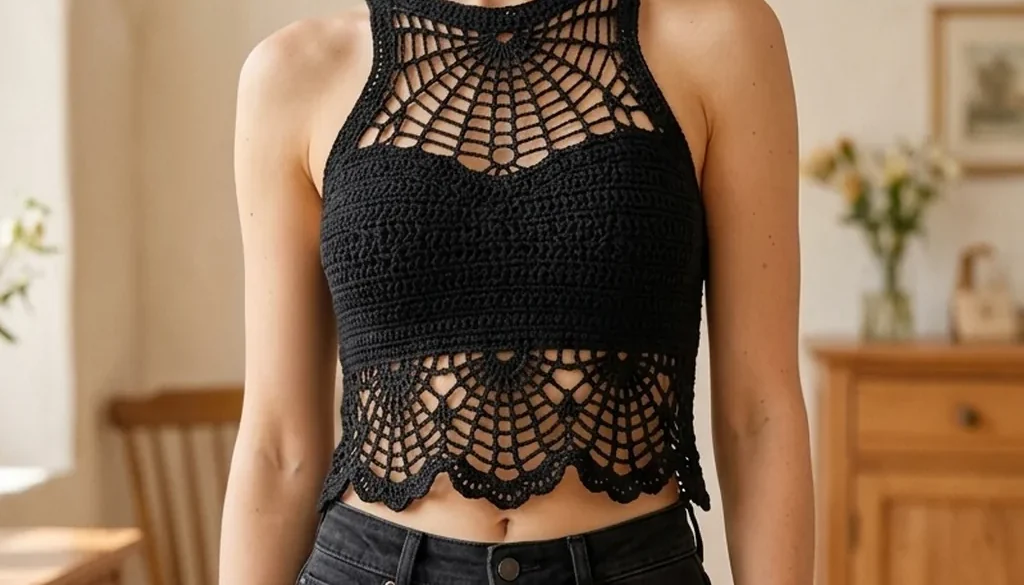
A spiderweb is one of the few Halloween motifs that works on clothing without turning the garment into a costume. Worked in black, at the right scale, it reads as lace from across a room and only resolves into a web when someone is close enough to look.
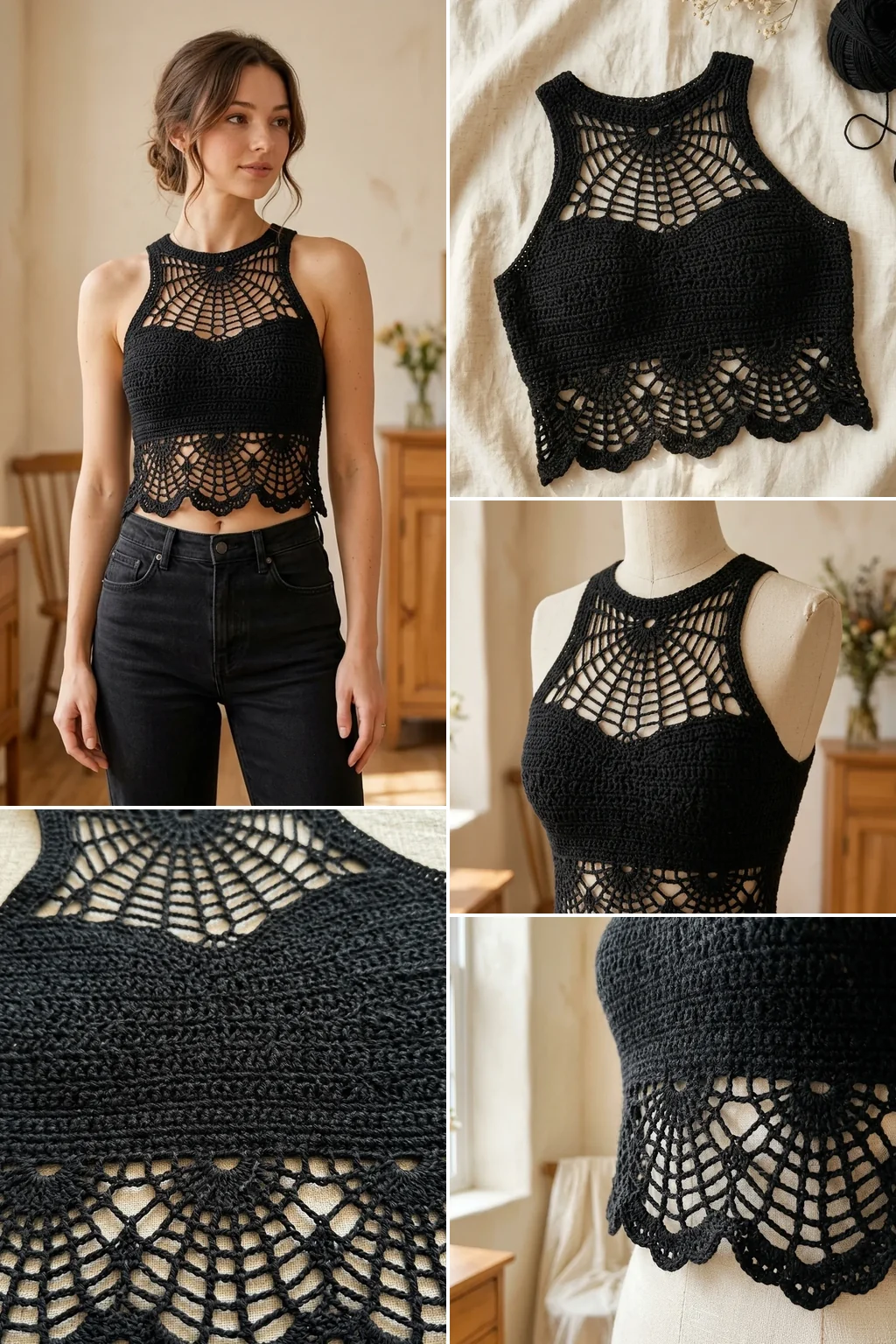
The top below puts the web where openwork belongs on a fitted garment: a fan radiating down from the neckline, a solid band through the middle, and a deeper band of web lace at the hem. The shape does the work, and the two openwork sections frame a body that stays opaque.
This is the midnight spiderweb crop top crochet pattern written as a construction guide rather than a fixed set of stitch counts, because a fitted top has to match the person wearing it and the two lace bands have to be sized to the body between them.
Midnight Spiderweb Crop Top at a Glance
| Skill level | Intermediate — lace, shaping, fitted garments |
| Yarn | Sport or DK cotton, black |
| Hook | 3.5 mm body, 3.0 mm lace bands |
| Time | 10–14 hours |
| Worked | Top down in the round, from the neckline |
| Three sections | Web yoke, solid body, web hem |
How the Top Is Built
Three sections, worked downward in one piece.
The web yoke starts at a high round neckline. Chain arcs radiate outward and downward from the neck edge, lengthening as the yoke widens, so the openwork spreads into a half-web across the upper chest and shoulders.
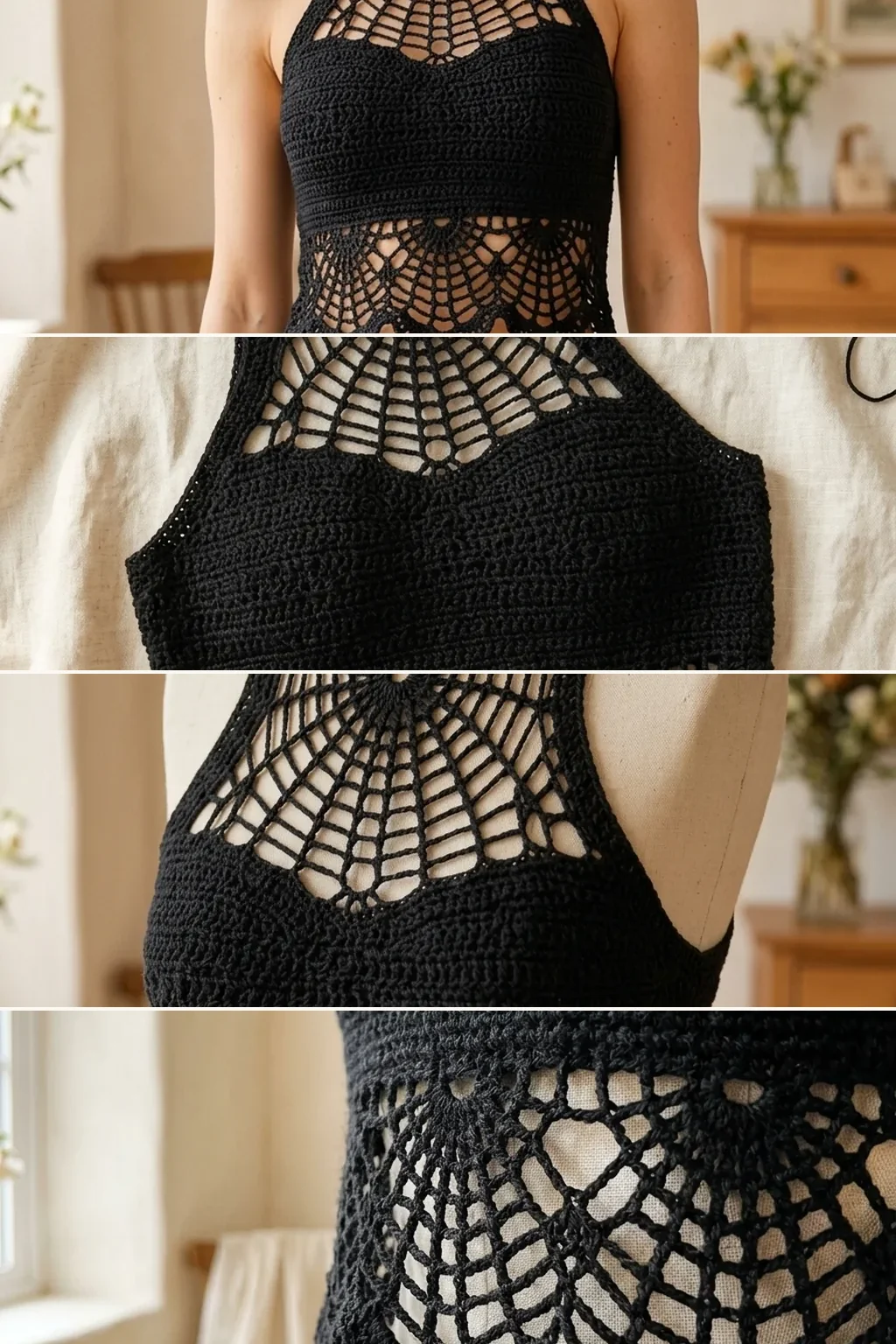
The solid body picks up where the yoke ends, just above the bust. From there to the lower chest it is plain dense crochet with no openwork at all — that section carries the fit and the coverage, and it is the reason this top needs nothing underneath.
The web hem is a deeper band of lace below the body, finishing in a scalloped edge. It repeats the yoke at a larger scale and is where the motif is most legible, because there is a hem edge to shape it against.
Working downward in the round means no side seams, and it means you can try the top on at the end of each section rather than discovering the fit at the end.
Materials
- 400–550 yards of black cotton in sport or DK, depending on size. Matte, not mercerised — a shiny black loses the lace entirely under a camera flash.
- 3.5 mm hook for the solid body, 3.0 mm for the two lace bands. The smaller hook keeps the openwork crisp where the body wants drape.
- Stitch markers, at least eight — one per web spoke on the yoke.
- Tapestry needle.
- Blocking mat and rustproof pins. Not optional on this one. Lace that has not been blocked is a tangle.
Cotton rather than acrylic, and matte rather than mercerised. Black acrylic goes shiny with wear and the shine flattens the shadow the web depends on. If you can only find mercerised cotton, a cool wash and a flat dry knock most of the gloss off before you start.
Sizing: This Top Is Meant to Be Too Small
Crochet crop tops are designed with negative ease — the finished garment measures less than the body it goes on, and the fabric stretches to fit. That is what stops a crochet top sagging after an hour of wear.
How much depends on the back. A top worked closed in the round takes about 2 inches of negative ease. One that ties or buttons takes considerably more: published designers work at 15 to 22 per cent and warn against going below 15 on a tie-back, because once it is tied the fabric stretches around the whole back and a loose top ends up with no support at all.
| Your bust | Finished, in the round | Finished, tie-back | Yarn |
|---|---|---|---|
| 32 in | 30 in | 26 in | 400 yds |
| 34 in | 32 in | 28 in | 440 yds |
| 36 in | 34 in | 29.5 in | 480 yds |
| 38 in | 36 in | 31 in | 515 yds |
| 40 in | 38 in | 33 in | 550 yds |
Pick by your actual bust measurement, within an inch either way. Length is personal: 13 inches from shoulder sits just above a high waistband, 15 inches sits at it.
Swatch twice
Measure your gauge swatch relaxed, then pin it stretched to roughly the tension it will be under on the body, and measure again. Published crop top patterns give both numbers for exactly this reason, and the calculations use the stretched figure.
A relaxed gauge tells you what the fabric is. A stretched gauge tells you what the garment will be.
Section One: The Web Yoke
A web is a hub, spokes radiating out, and chains strung between them in widening rings. On a yoke you are working half of that: the neckline is the hub, the spokes fan downward and outward, and each row of chain arcs is one ring of the web.
- Foundation: chain to your neck circumference plus two inches and join into a ring. A high round neckline wants to clear the head without a fastening, so measure over the head, not around the throat.
- Set the spokes: work a round of chain 1, double crochet repeated, placing eight evenly spaced markers as you go. Those eight points are the spokes.
- Round 2: chain 5, double crochet into the next marked point around. The chain-5 loops are the first ring of the web.
- Round 3: the same, with chain 7.
- Round 4: chain 11.
- Round 5: chain 17.
Each round roughly doubles the chain length minus a little, because the circumference grows faster than the number of spokes. Those numbers are a working sequence rather than a law — if the yoke ripples, the chains are too long for the round; if it cups and pulls at the shoulders, too short.
Stop the yoke just above the bust. That is the whole design decision in this garment. Openwork belongs across the collarbone and shoulders where it reads as lace; carried further down it stops being lace and starts being a hole, and a top that needs something underneath to be wearable is a top you will not wear.
For most sizes four or five rings gets you there. Try it on before deciding — the yoke should finish about an inch above the fullest part of the bust.
Section Two: The Solid Body
From the end of the yoke, switch to the 3.5 mm hook and work dense fabric in the round with no openwork.
Half double crochet is the stitch to use. It gives a dense fabric with stretch across the round, which is what negative ease needs. Plain double crochet works and uses less yarn but stretches lengthways under its own weight, which on a crop top means it grows into a regular top by the end of an evening.
- Transition round: work half double crochet into every chain space and every stitch of the last yoke round, adjusting the count to your finished bust measurement from the table above.
- Armholes: divide for the arms by working flat across the front and back separately for 2 to 3 inches, then rejoin in the round below them. On a racerback, take the back narrower than the front.
- Body: continue in the round until the solid section reaches the lower chest, about 3 to 4 inches below the armholes.
This section is the fit. Try the top on at the end of it, and if it is tight across the bust the answer is a half size larger hook for the remaining rounds rather than more stitches, which would change the silhouette.
Dividing for the armholes
The division is the fiddliest part of the whole top, and it is worth slowing down for because it sets where the shoulders sit.
Work to the point where the armhole should start — usually an inch or so below the end of the yoke — then stop working in the round. Work back and forth across the front only for the depth of the armhole, turning at each end. Fasten off, rejoin at the other side, and do the same across the back.
Armhole depth runs about 6 inches for a 32-inch bust and 8 inches for a 40-inch one. Deeper feels generous on the hanger and gapes when you raise your arms; shallower binds. If you are between sizes, go shallower — a tight armhole is a half-inch fix at the edging stage and a loose one is not.
For a racerback, decrease one stitch at each end of every other row across the back only, until the back is about four inches wide between the shoulder blades. The front stays at full width. That difference is what holds the top on the shoulders without a strap or a fastening.
Rejoin in the round below the armholes and carry on. Finish each armhole with two rounds of single crochet once the whole top is done, not before — the edging is what evens out the join between the worked-flat and worked-round sections.
Section Three: The Web Hem
The second lace band is the same idea as the yoke, worked in the other direction and at a larger scale.
- Set the spokes: a round of chain 1, double crochet, with twelve to sixteen marked points this time rather than eight. More spokes across a wider circumference keeps the scallops in proportion.
- Build the arcs: three or four rounds of lengthening chains between the marked points, the same sequence as the yoke.
- Scallop the edge: finish each arc with a fan of double crochet worked into the chain space — five or seven stitches per fan — which turns the last ring into a scalloped hem rather than a row of loops.
Work the hem band deeper than the yoke. On the body it has more room, and a shallow hem band reads as an unfinished edge rather than a design.
Blocking, Which Is Not Optional Here
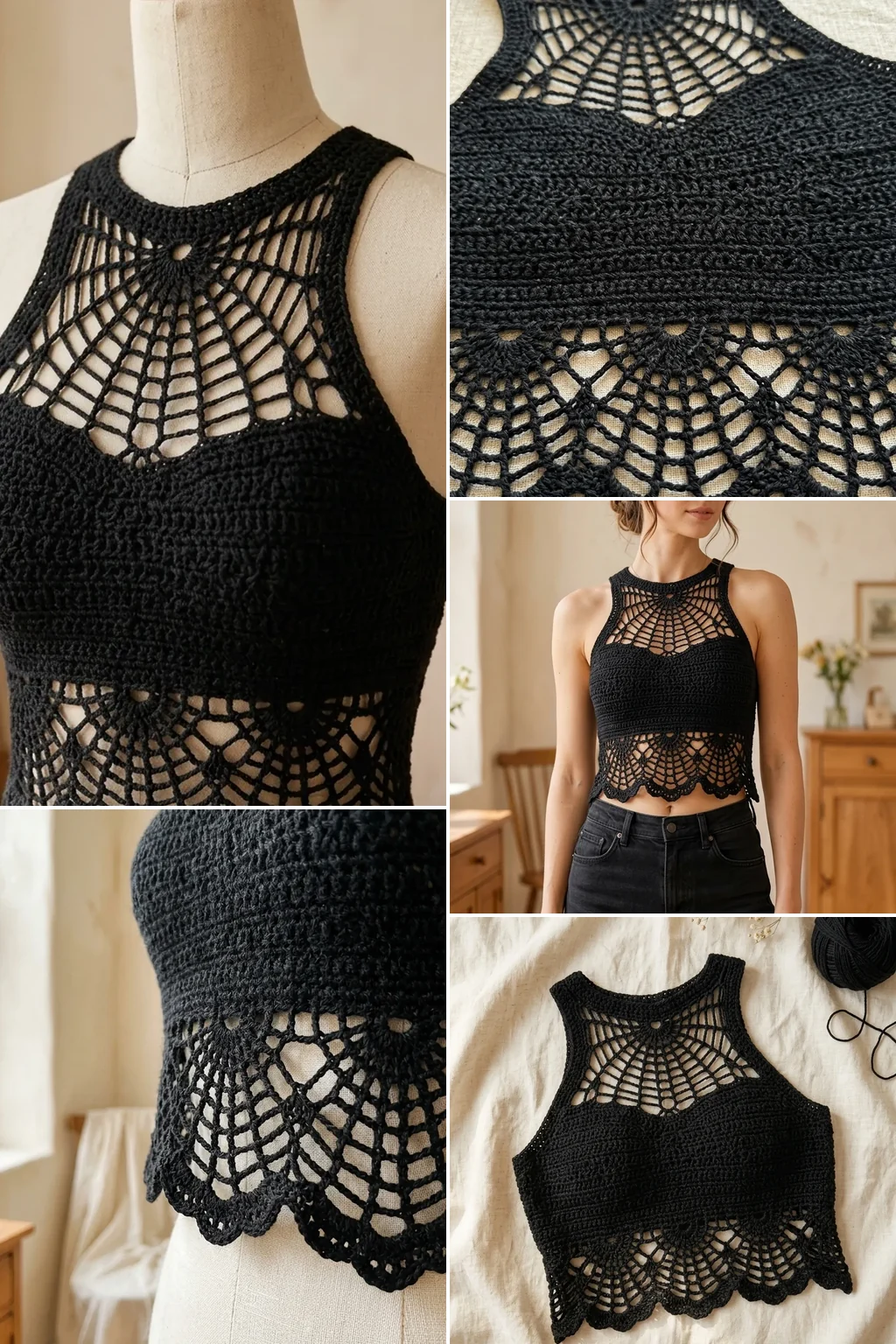
Pin the finished top out damp, flat, with every chain arc pulled into shape and the scallops evenly spaced, and leave it to dry completely.
Unblocked lace is a pile of loops. The yoke will look like a tangle of chains and the hem scallops will curl inward, and neither tells you anything about the finished garment. Blocking is what turns both bands into the pattern they are supposed to be, and on cotton it only needs doing once.
Pin to the measurements you worked to, not to whatever shape it happens to take. Lace will stretch to almost anything while damp, which makes it easy to block a size larger by accident.
10 Midnight Spiderweb Crop Top Ideas
1. Classic Black on Black
The version above. Matte black throughout, web yoke, solid body, scalloped web hem, high neckline.
Keep both lace bands in the same black as the body. A contrast band turns a wearable top into a costume piece.
Intermediate · 12 hours · 440 yds
2. Deeper Hem Band
The hem lace taken to five or six rounds so it occupies the lower third of the top, with the solid section shortened to match.
Do not extend the yoke to balance it. The two bands are meant to be different depths — matching them makes the top read as striped.
Intermediate · 12 hours · 450 yds
3. Yoke Only
Web at the neckline, plain fabric all the way to a straight hem. The quietest version, and the one that works outside October.
Finish the hem with two rounds of single crochet. A plain top needs a defined edge where a lace band would have been.
Intermediate · 10 hours · 420 yds
4. Deep Plum Lace
Black body with both web bands in a deep plum. Reads as Halloween at close range and as a design detail at any other time of year.
Pick a plum dark enough to be a shadow rather than a colour, or it tips into fancy dress.
Intermediate · 12 hours · 440 yds
5. Longer Length Tank
The same three sections at 18 inches, with the solid body extended. Sits below the waist and stays wearable all autumn.
Add an inch of width through the lower body. A longer top needs to clear the hip, not grip it.
Intermediate · 14 hours · 520 yds
6. Racerback
The back narrowed to about four inches between the shoulder blades, with the yoke lace carried across it.
Narrow the back over several rounds rather than all at once, or the lace distorts where the decreases land.
Intermediate · 12 hours · 440 yds
7. Web Sleeves
Short cap sleeves worked in the same lace as the yoke, picked up around each armhole.
Two rounds only. Lace sleeves longer than that catch on everything and lose their shape at the opening.
Intermediate · 13 hours · 490 yds
8. Charcoal Body, Black Lace
A charcoal solid section with both web bands in true black, so the lace reads darker than the fabric it frames.
Go one shade apart, not two. A wide gap makes the bands look stitched on rather than worked in.
Intermediate · 12 hours · 440 yds
9. Matching Web Choker
One small round web on a black cord, made from the leftovers in about twenty minutes.
Three rings, not four. A larger web sits off the throat and swings.
Beginner · 30 min · 20 yds
10. Web Band on a Plain Tee
The hem band alone, worked separately and sewn to the bottom of a shop-bought cotton tee.
Stitch into the hem seam of the tee rather than the body fabric, which has no stability and puckers.
Beginner · 3 hours · 90 yds
Common Problems and Fixes
The yoke ripples instead of lying flat
The chains are too long for that round. Take the round out and work it two or three chains shorter. Blocking flattens a mild ripple; it will not rescue a round that is badly over-chained.
The yoke pulls across the shoulders
The opposite problem — chains too short for the circumference. Each round needs noticeably more chain than the one below, because the distance between spokes grows as the yoke widens.
The lace sits over the bust
The yoke was carried too far down. Stop it an inch above the fullest part of the bust and start the solid section there. This is the one measurement worth trying on for rather than calculating.
The hem scallops curl inward
Almost always blocking, or the lack of it. If they still curl after a proper block, the fans have too few stitches — go from five double crochet per fan to seven.
The top rides up
Not enough negative ease, or double crochet used for the body. A crop top with no grip at the solid section travels upward with every movement.
The neckline will not go over my head
Measured around the throat rather than over the head. A high round neck with no fastening has to clear the skull, which is a bigger measurement than it feels like. Add two inches and redo the foundation.
Washing and Keeping Its Shape
Hand wash in cool water. Black cotton releases dye for the first few washes, so wash it alone the first two times and never with anything pale.
Press the water out between towels and dry flat, reshaping to the measurements it was made to. A fitted cotton top hung wet stretches at the shoulders and never fully returns, and on a garment designed with negative ease that loss is the difference between fitted and loose.
Both lace bands need pinning out again after a wash. Two minutes with pins while they are damp keeps the web crisp for the next wear.
Frequently Asked Questions
How much yarn does a spiderweb crop top take?
400 to 550 yards of sport or DK cotton depending on size. The two lace bands together use about 90 yards of that.
Do I need to wear anything underneath?
No. The solid section covers the bust by design, and the openwork sits at the neckline and the hem. That is why the yoke stops where it does.
Can a beginner make this?
It is an intermediate project. The web arcs themselves are beginner-level, but fitting a garment with negative ease and dividing for armholes are not.
Where exactly should the yoke stop?
About an inch above the fullest part of the bust. Try it on rather than calculating — bodies differ more than schematics do.
Why does my lace ripple?
Too much chain on that round. Each ring needs more chain than the one below, but the increase slows as the circumference grows.
What is negative ease and why does this top need it?
The finished garment measures smaller than the body and stretches to fit. Without it, a crochet top sags within an hour. Around 2 inches worked in the round, 15 to 22 per cent for a tie-back.
Do I have to block it?
Yes. Unblocked lace is a pile of loops — the yoke looks like a tangle and the hem scallops curl. On cotton it only needs doing once.
What yarn works best?
Matte black cotton in sport or DK. Mercerised cotton and black acrylic both go shiny, and the shine flattens the shadow the web depends on.
Can I make it without dividing for armholes?
Not on a fitted top. Without the division the fabric bunches under the arm, and on a cropped garment there is no length for it to go.
How long does the whole top take?
Ten to fourteen hours. The two lace bands are about three hours of that, including blocking.
Final Thoughts
Work the yoke and try it on before you go any further. Where it stops decides whether this is a top you wear or a top you admire in a drawer, and no amount of calculation substitutes for holding it against yourself.
Then pick the body stitch for how it behaves rather than how it looks. Half double crochet for stretch across the round is what makes negative ease work, and a dense textured fabric like the alpine stitch is the wrong choice here for the same reason it is the right one for a blanket. The same rule about stopping openwork where the body needs coverage applies to any motif-led garment, including a blush butterfly cardigan, where the mesh works because there is a layer under it.