 Clara•🕑 October 7, 2026•💬 No comments
A crochet Christmas garland gives you the one decoration that covers a tree, a mantel and a staircase with the same project, and the reason so many end up limp is that they were planned as an afterthought. This guide covers how long to make it, which yarn survives a month of hanging, how to join motifs, and 9 garland ideas you can start tonight. Pick the idea that matches your skill, then follow the sizing and yarn tables to avoid running out of yarn at the last motif.
Crochet Christmas Garlands at a Glance
- Skill level: beginner to intermediate, depending on the idea
- Time: one evening for a strip, up to a week for stiffened motifs
- Yarn: cotton or wool blend,
worstedorbulkyweight - Hook:
4 mmto8 mmfor motifs, up to19 mmfor a giant strip - Length: about 1 yard per foot of tree height
- Start by: early November
Plan the Length Before You Pick the Yarn
A garland that comes up half a yard short is the most common reason one gets abandoned. Measure first, because the length decides how much yarn you buy and how many motifs you make.
For a tree, measure the height and plan one yard per foot for a loose swag. Wrap a tape measure around the tree where the garland will sit to check, since a wide tree needs far more than a tall slim one. For a mantel or banister, measure the span and add a third so the garland drapes instead of stretching tight.
| Where it hangs | Measure | Garland length | Motifs at 4 in each |
|---|---|---|---|
| Mantel, 5 ft | Span | 6 to 7 ft | 18 to 21 |
| 4 ft tabletop tree | Wrap | 4 yards | 36 |
| 6 ft tree | Wrap | 6 yards | 54 |
| 7 ft tree | Wrap | 7 yards | 63 |
| Staircase, 12 ft | Rail length | 14 ft | 42 |
These numbers assume motifs placed edge to edge. Space them with a 6 in chain between and you need about a third fewer motifs, which is how you finish a tree-sized garland in a fortnight.
Choose Yarn That Hangs Well for a Month
A garland carries its own weight for weeks, and the wrong fibre sags overnight. Match the fibre to the job.
| Yarn | Drape | Holds shape | Best for |
|---|---|---|---|
| Mercerised cotton, worsted | Structured | Excellent | Stiffened motifs, stars, snowflakes |
| Wool blend, bulky | Soft, full | Good | Strips, pom-pom ropes |
| Acrylic, worsted | Limp | Poor | Pennants, scrap colour work |
| Cotton thread, size 10 | Fine | Excellent after stiffening | Snowflakes and lace |
| Metallic thread held with cotton | Sparkling | Good | Stars and accents |
Cotton is the safest first choice. It does not stretch under the weight of the motifs, it takes stiffener evenly, and it stays safe near LED lights. Acrylic is fine for pennants because pennants hang flat, but it sags in anything with weight.
The Basic Strip: How It Is Built
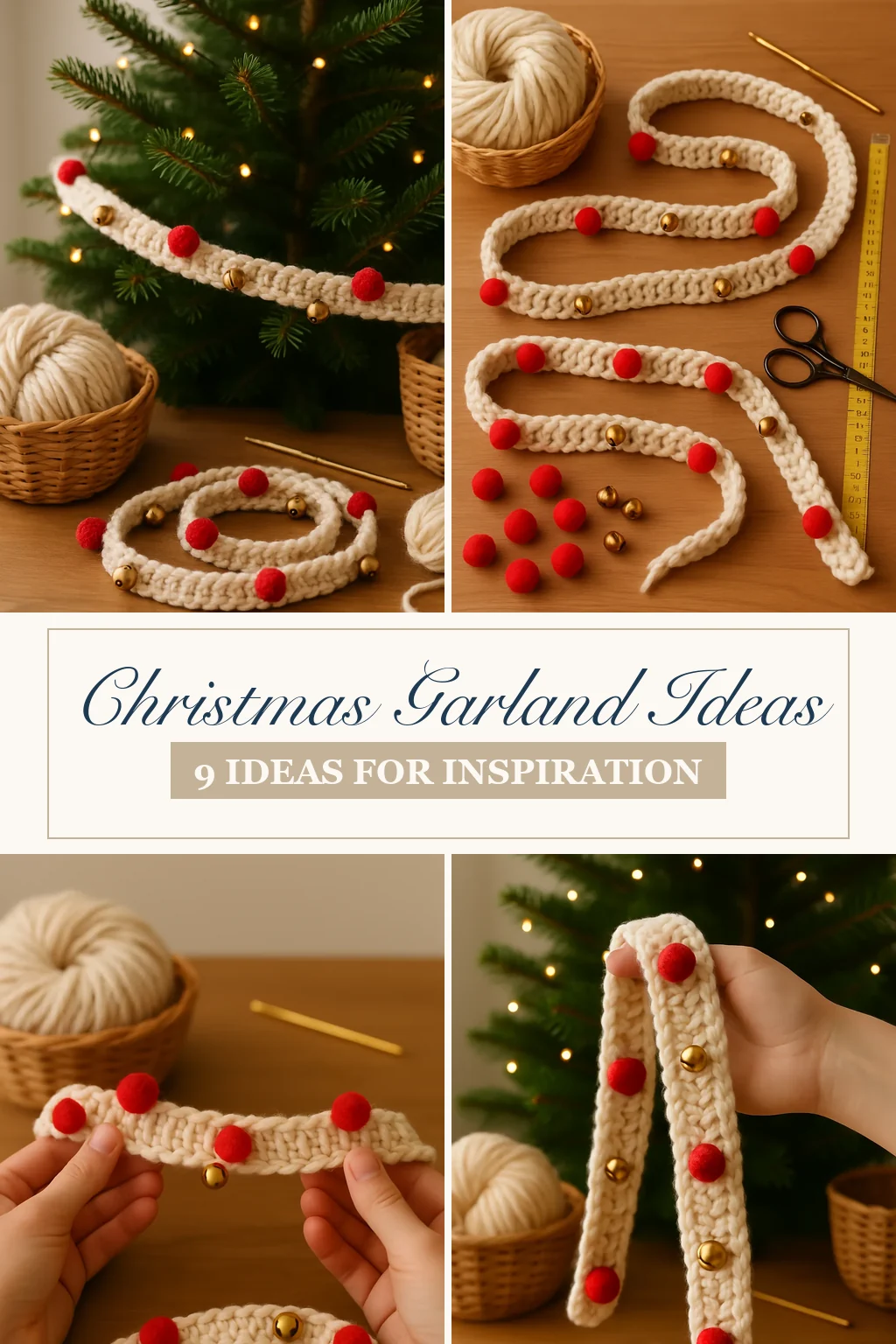
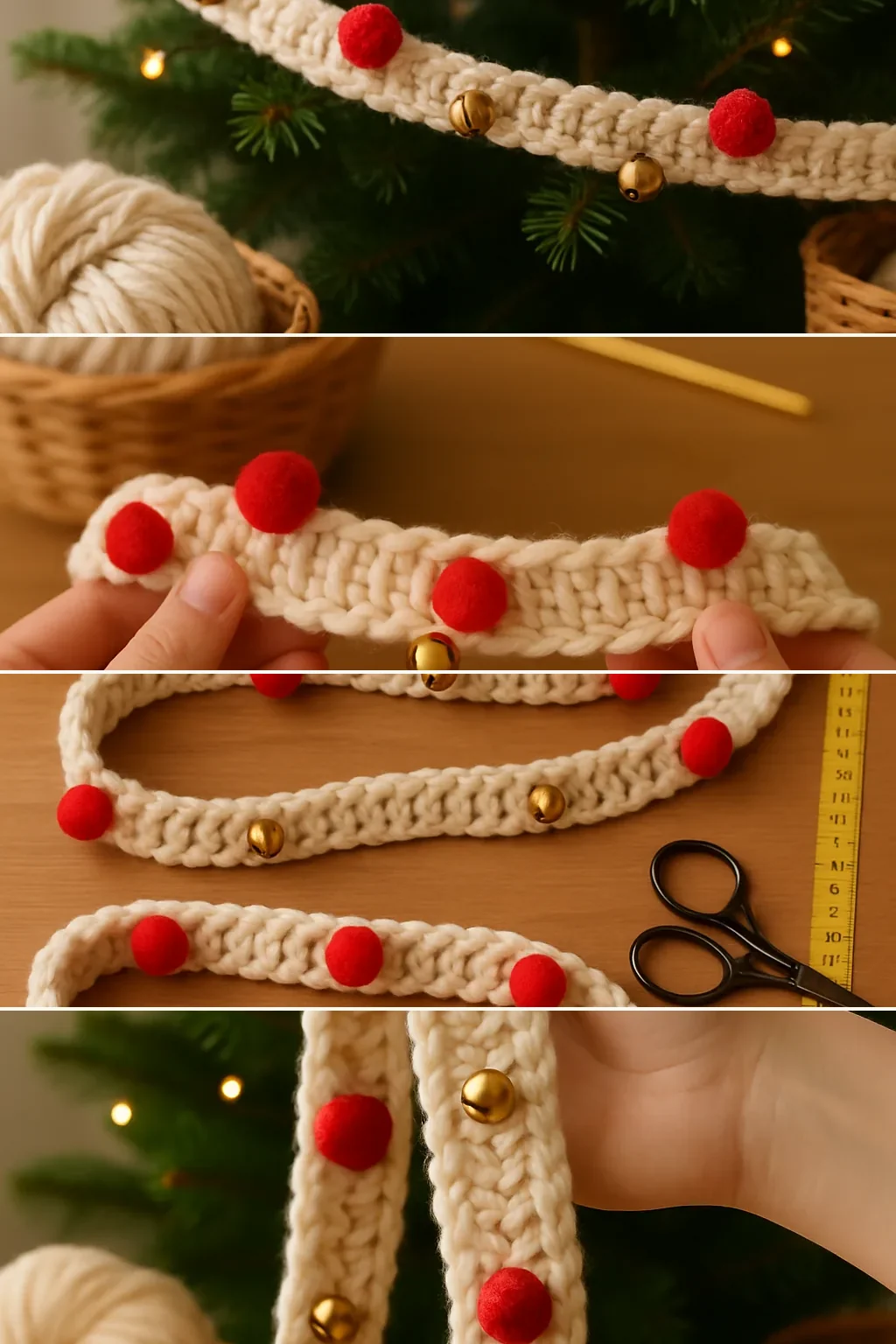
The simplest garland needs one stitch and no joining. It is a long chain worked into a single row of single crochet, and it follows the same method as established free patterns, including a 6 ft strip in super bulky yarn with a 19 mm hook.
Work the foundation chain
Chain about 90 stitches in super bulky yarn for a 6 ft garland. Chain loosely, since a tight foundation row pulls the strip into a curve.
Work the single crochet row
Start in the second chain from the hook and work 1 sc into every chain across. Count as you go every 20 stitches. That is the whole garland, so tension matters more than anything: keep every stitch the same size and the strip lies flat.
Finish and dress it
Fasten off and weave in the ends. A 6 ft strip uses roughly 10 to 20 yards of super bulky yarn. Add jingle bells, pom-poms or small ornaments clipped on with ribbon once the strip is finished. The dressing is what makes the garland yours.
How to Join Motifs Into a Garland
Most of the ideas below are individual motifs, and the way you connect them decides how the garland hangs. There are three methods.
Chain between motifs
At the end of each motif, chain 15 to 20 and slip stitch into the next motif. The garland becomes one continuous piece, and the chain doubles as the spacing. It is the neatest method and the least forgiving, because a broken motif means unpicking.
Thread onto twine
Make a small hole or loop in each motif, then thread jute twine through with a tapestry needle. You can swap motifs between years, space them any way you like and repair a single one without touching the rest.
Clip to a base strip
Hang motifs from the basic strip with small ribbon loops or clips. This suits heavy motifs, because the strip carries the weight and the motifs can be removed for washing.
9 Crochet Christmas Garland Ideas
These nine are real, makeable garlands, ranked from easiest to hardest in roughly that order. Pick one and finish it before starting a second, because a finished garland beats three half-finished ones.
Chunky Single Crochet Strip Garland
A single row of sc worked along a foundation chain, finished at 6 ft, is the simplest garland that still looks designed. Use super bulky yarn with a 15 mm to 19 mm hook and the stitches fall into soft, pillowy ridges. It teaches even tension on a long chain, which carries into every blanket you make afterwards.
Hang it in loose loops from small clear hooks and the ridges catch shadow, which gives the strip depth without any extra decoration. Work it in two colours held together for a marled look, and the finished strip hides small tension wobbles.
Beginner · 1 evening · about 20 yards of super bulky yarn
Mini Stocking Bunting
Twelve miniature stockings in red, cream and green hang from a chain, each small enough to fit one toffee. Make each in a 4 in height with a 4 mm hook. It teaches heel and toe shaping at a scale that finishes in 20 minutes per stocking.
Make each stocking in a different colour combination from one palette, then add a contrast cuff of two rows. Hang them from a jute cord with a small chain loop sewn to each cuff, and the line reads as bunting rather than a row of toys.
Intermediate · 4 hours · 100 yards of worsted
Snowflake Chain Garland
Six-point snowflakes in white cotton thread, stiffened and strung with a chain between each. They catch the light on a dark mantel in a way yarn cannot. The project teaches blocking and stiffening, the two steps that turn lace into an ornament.
Stiffen each snowflake on a flat board and pin the six points evenly before it dries. Link them with a 4 in chain at the tip of one point, and the whole garland moves slightly in warm air from a radiator.
Intermediate · 6 hours plus drying · 150 yards of size 10 cotton thread
Pennant Flag Bunting
Triangular flags worked by decreasing one stitch at each end of every row, hung from a jute cord. Alternate three colours and the line looks like a village of tiny roofs. It teaches the decrease that shapes every triangle shawl.
Make the flags 4 in tall for a mantel and 6 in for a staircase, and keep the same number of rows in each so the line hangs level. Sew each flag to the cord with two stitches at the top corners.
Beginner · 3 hours · 80 yards of worsted
Granny Triangle Garland
Small granny triangles in bright festive colours, joined by a short chain. Each one uses leftover yarn, so it clears the scrap basket. It teaches the corner cluster of a granny square in a form that finishes in half an hour.
Use the same three colours in every triangle but rotate which colour forms the outer round. That small change makes every triangle different while the garland still looks like a set.
Beginner · 5 hours · 120 yards of worsted in 4 colours
Holly and Berry Bobble Garland
Flat holly leaves in dark green with clusters of red bobbles at each join. The bobble stitch is the reason to make it, because it builds the berry in one stitch. Practise the bobble on a swatch before committing to the real thing.
Make the berries from three-stitch bobbles in a single round and fasten off tightly, so they stand proud of the leaf. Space one cluster per join and keep the leaves facing the same way.
Intermediate · 5 hours · 90 yards of green, 20 yards of red
Gingerbread Person Chain
A row of flat gingerbread people holding hands, with white duplicate-stitch icing. Hands join as the arms touch, so no joining chain is needed. It teaches shaping a small figure from a single flat piece.
Add the white icing after the figure is finished, using a tapestry needle and a single strand. Keep the buttons to three per figure, because more crowds a figure this small.
Intermediate · 4 hours · 60 yards of tan worsted
Pom-Pom and Bell Rope
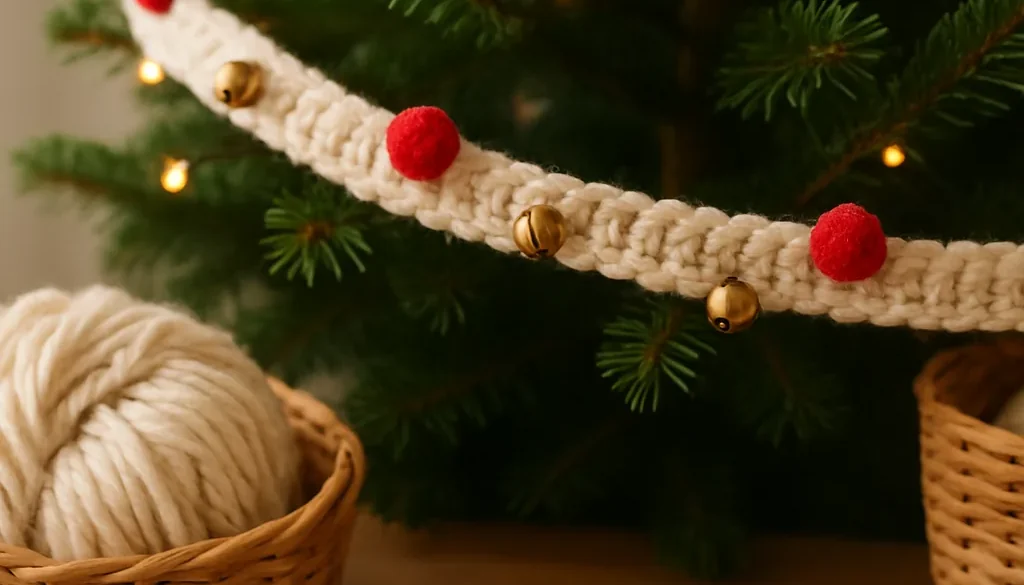
A twisted cord of three yarn strands with red pom-poms and small brass bells knotted in every 8 inches. No crochet beyond a simple chain is required, which makes it a good first project for children. It teaches how spacing decides whether a garland looks organised or messy.
Knot each bell on with a short tail of yarn instead of glue, so it can come off for washing. Tie the pom-poms in groups of three at one end of the cord for a tassel effect at the corner of a mantel.
Beginner · 2 hours · 40 yards of any weight
Star Chain Garland
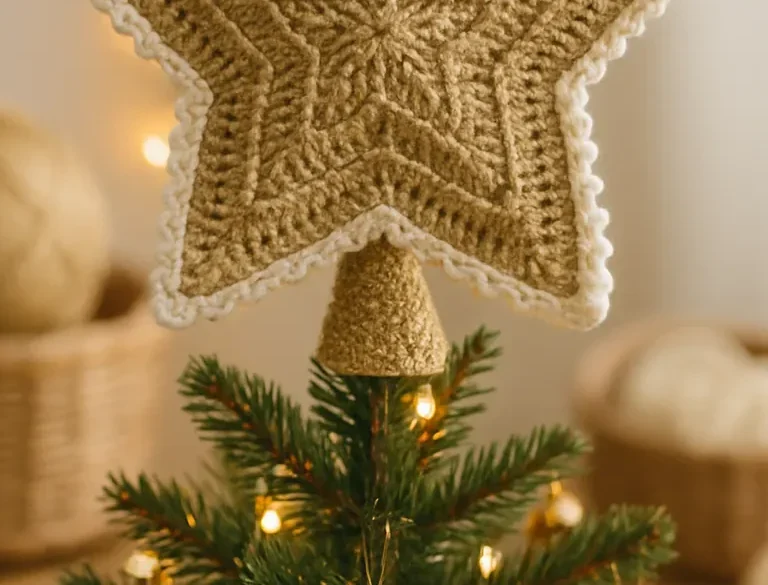
Small five-point stars linked by chains, in the same gold-with-cotton combination used for the gold star tree topper. Stiffen each star so it holds its points. It teaches the foundation-count rule that makes a five-point star work.
Alternate gold stars with small cream pom-poms so the garland has pauses between points. Link each star at the tip of one point with a 5 in chain, and hang the garland where the light falls across it.
Intermediate · 6 hours · 100 yards of gold metallic with cotton
The heart motif from the Christmas heart lace table runner also converts to a garland. Stiffen a dozen hearts and string them on twine, and the lace pattern you already know becomes a mantel decoration.
Colour Combinations That Look Designed
Three colours look deliberate and five look accidental, so pick a palette before you pick the yarn.
| Palette | Colours | Mood |
|---|---|---|
| Classic | Cream, red, forest green | Traditional, suits any tree |
| Scandinavian | White, grey, one red accent | Quiet, modern |
| Woodland | Natural jute, dark green, rust | Rustic |
| Frosted | Ice blue, white, silver thread | Cool, wintery |
Repeat the same three colours in the same order along the whole garland. A repeating order makes even imperfect stitches look planned.
Where to Hang a Crochet Garland
Each location asks something different of the garland, so match the idea to the place before you start.
On the tree
Start at the top and spiral downward, tucking the garland into the branches rather than laying it on the surface. Lightweight crochet will not bend the branches, and a bulky strip sits well against dense needles. Add lights after the garland so the bulbs show through the stitches.
Across a mantel
A mantel garland is seen at arm length, so detail pays off here. Stiffened snowflakes, stars and holly show up well. Allow a drape of about 6 in at the centre and fix the ends with removable adhesive hooks.
Along a staircase
Banisters need length and weight, so choose the strip or a pennant line that can be extended with extra motifs. Tie the garland to the rail every 18 in with ribbon so it does not slide when someone pulls on the handrail.
Over a window or doorway
Pennants and pom-pom ropes hang well across a frame. Use small clear hooks along the top and keep the line level by measuring from the ceiling instead of the sill.
Finishing Touches That Make It Look Shop Quality
A garland finishes in three stages: weave in ends, block, and dress. Skipping the middle one is the usual mistake.
| Finish | How | Works on |
|---|---|---|
| Wet blocking | Soak, press out water, pin flat to dry | Cotton motifs, hearts, leaves |
| Steam blocking | Hold the steam above the fabric and never press | Acrylic pennants |
| Stiffening | Dip in fabric stiffener, pin to foam, dry overnight | Stars, snowflakes |
| Edging | One round of sc in a contrast colour |
Pennants, stockings |
Steam blocking acrylic is safe only if the iron never touches the yarn, because acrylic melts under direct heat. Hold the steam a few centimetres away and let the fabric relax on its own.
Choosing Your First Garland
If you have never made a garland, choose by time and confidence rather than looks.
- One evening: the chunky strip or the pom-pom and bell rope
- One weekend: the pennant flags or the granny triangles
- A few weeks: the stocking bunting, holly and berry, or gingerbread chain
- A project to be proud of: the stiffened snowflakes or star chain
Finish one and you will know your own tension, how much yarn each motif uses, and how long you really take per motif. That knowledge makes the second garland faster and the third almost automatic.
Common Problems and Fixes
The garland stretches and sags
Heavy motifs on a thin chain pull the chain out of shape. Use cotton, drop down a hook size, and hang the garland from more points so each section carries less weight.
The motifs curl at the edges
Flat motifs worked in rounds curl when the stitch count is short. Block each one with pins and steam held away from the fabric, or stiffen them so they set flat.
You run out of yarn at the last motif
Weigh your yarn before you start and make one motif to measure how much it uses. Multiply by the number of motifs, add 15 percent, and buy that amount in a single dye lot.
The colours bleed on stiffener
Test one motif first. Deep reds sometimes run into pale yarn when wet, so stiffen red motifs separately from cream ones and let each dry fully.
Storing Your Garland Between Years
Coil it loosely around a cardboard tube, wrap it in tissue and keep it in a dry box. Folding a stiffened motif cracks it along the fold, and a damp loft softens stiffener within a year. A garland stored well comes out of the box looking the way it went in.
Frequently Asked Questions
How long should a crochet Christmas garland be?
Allow about 1 yard of garland for every foot of tree height for a loose swag, so a 6 ft tree takes roughly 6 yards. For a mantel, measure the span and add a third for the drape.
What yarn is best for a Christmas garland?
Cotton or a wool blend in worsted or bulky weight. Cotton holds its shape and takes stiffener well, while a wool blend gives a softer, fuller strip.
What hook size should I use?
Use 5.5 mm for worsted weight motifs and 8 mm for bulky strips. Go down one size from the label if you want motifs that stay firm.
How do I join crochet motifs into a garland?
Chain 15 to 20 stitches between motifs and work a slip stitch into the next motif, or thread the motifs onto jute twine through a tapestry needle. Chains give a continuous look and twine lets you swap motifs year to year.
Can I hang a crochet garland on a real tree?
Yes. Crochet is light, so it will not weigh down branches, and cotton is safe near LED lights. Keep it away from candles and any open flame.
How do I stop a garland from stretching?
Choose cotton over acrylic, work with a smaller hook, and store it flat or loosely coiled rather than hung. Heavy motifs on a thin chain pull out of shape over a season.
How far ahead should I start?
Start in early November. A simple strip takes an evening, but a garland of 20 individual motifs takes several weeks of short sessions.
Can beginners make a crochet Christmas garland?
Yes. A strip of single crochet needs only a chain and one stitch, and pennants or granny triangles add just a turning chain and a few increases.
Final Thoughts
Measure your tree or mantel, pick a three-colour palette, and choose the idea that matches the time you have. The strip finishes in an evening, and the stiffened motifs reward a few weeks of patience. Start in early November and the garland will be on the tree before the first decorations come out of the loft.