 Clara•🕑 October 22, 2026•💬 No comments
A baby blanket is the most-given handmade gift there is, and the one most likely to be made at the wrong size. Published charts disagree by a foot in places, and the difference between a pram blanket and a crib blanket is the difference between something used daily and something folded in a drawer.
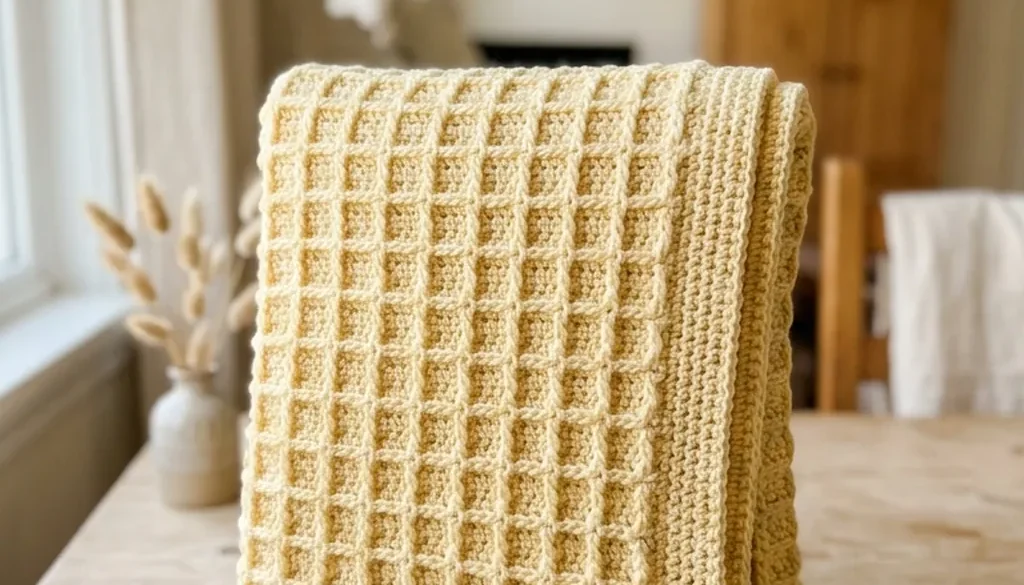
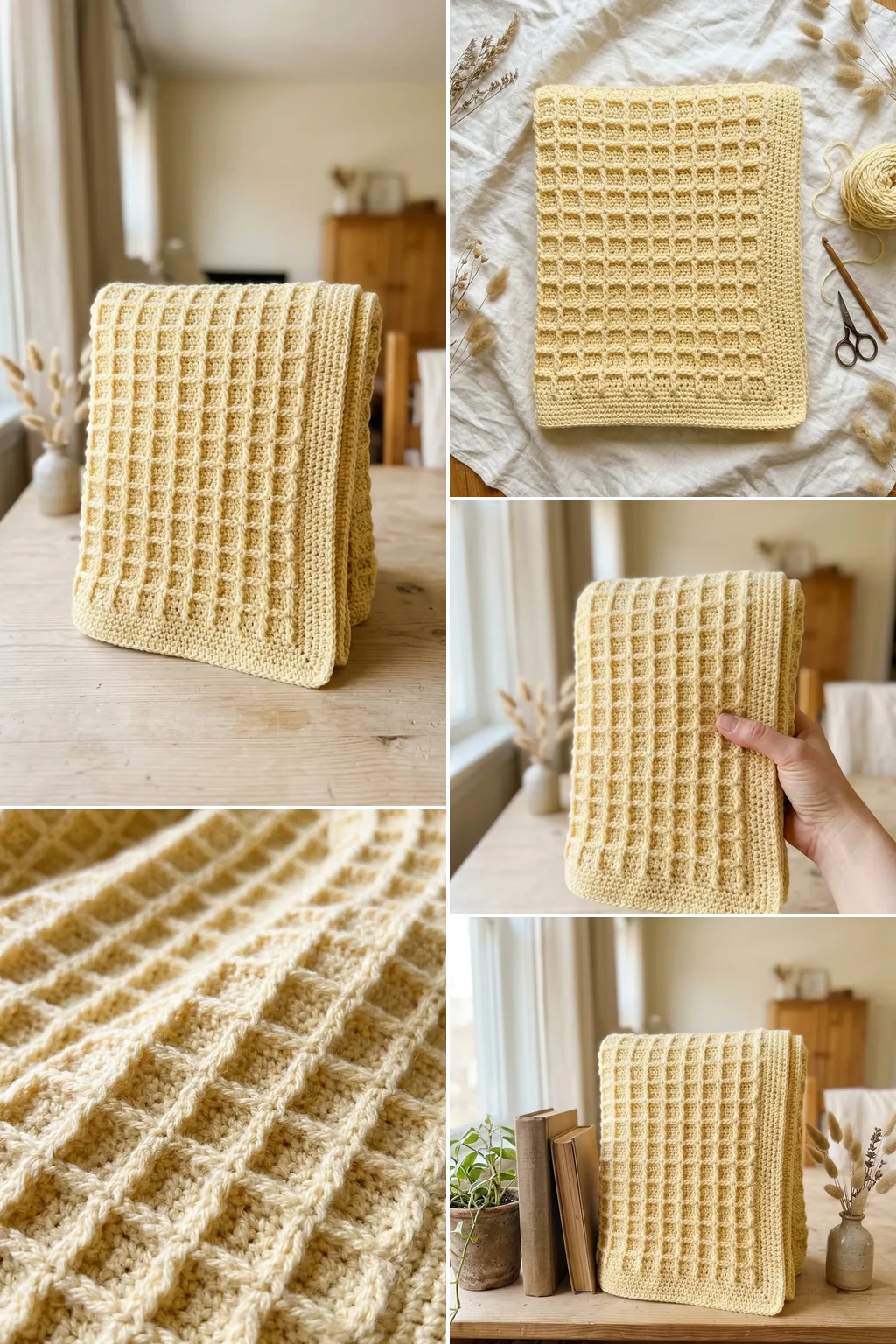
This one is a honeycomb fabric in buttercream — a textured grid of raised cells that suits the theme without needing a single appliqué, and which is closed enough that nothing catches a finger.
Below is the buttercream honeybee baby blanket crochet pattern as a complete guide: picking the size by how it will be used, the fabric, the border, and the safety points that actually matter rather than the ones that get repeated.
Buttercream Honeybee Baby Blanket at a Glance
| Skill level | Confident beginner — dc and front post dc |
| Fabric | Honeycomb waffle, a multiple of 6 plus 1 |
| Yarn | Machine-washable DK |
| Hook | 4.0–4.5 mm |
| Time | 12–25 hours by size |
| Best for | Pram, tummy time, wrapping |
Size by How It Will Be Used
Baby blanket charts disagree with each other, and the age on a label tells you nothing. What decides the size is where the blanket will actually be.
| Type | Size | Used for | Yarn | Time |
|---|---|---|---|---|
| Lovey | 12 × 12 in | Held, carried, chewed | 150 yds | 3 hrs |
| Pram / stroller | 30 × 36 in | Over a pushchair, car seat | 700 yds | 14 hrs |
| Receiving | 36 × 36 in | Wrapping, tummy time | 850 yds | 17 hrs |
| Play mat | 40 × 40 in | Floor, under a baby | 1,050 yds | 21 hrs |
Published sizes support these ranges: a lovey sits around 10 to 12 inches square, a receiving blanket between roughly 30 and 40 inches square, and a pram blanket around 30 by 35 to 30 by 40. Crib blankets are commonly listed at 30 by 36, though some charts go considerably larger.
The yardages are working estimates from the fabric below rather than figures from a chart — honeycomb is a dense textured stitch and uses noticeably more than plain double crochet over the same area. Buy one more skein than you calculate.
Homemade sizes are approximate and that is normal. Hook size, tension and gauge all vary between makers, so two people working the same pattern finish at different dimensions. Work to the measurement, not to the stitch count in someone else’s pattern.
Where This Blanket Is For
Worth being straight about, because it changes what you make.
The American Academy of Pediatrics’ safe-sleep guidance is to keep loose blankets, pillows, soft toys and bumpers out of a baby’s sleep space. A handmade blanket is a loose item. That guidance does not mean do not make one — it means this is a pram, tummy-time and wrapping blanket, not a crib blanket, and it is used with an adult present.
That framing is useful rather than restrictive. It means you can make something beautiful at 36 inches square without worrying that it is the wrong thing, and it is worth saying on the gift tag so a new parent does not have to work it out.
Yarn, and an Honest Note on Fibre
Machine washable is the only non-negotiable. A baby blanket that needs hand washing will be washed in a machine anyway, at some point, by someone exhausted. Buy for that.
Beyond that, published advice conflicts, and it is worth knowing rather than being told. Some sources recommend acrylic or acrylic blends for durability and easy washing; others advise avoiding acrylic because it can trap heat. Cotton, bamboo and superwash merino all get recommended too.
The defensible position is about weight rather than fibre: a thick, dense blanket can overheat a wrapped baby whatever it is made of. So a DK or sport weight rather than chunky, in a fibre that washes well, is the choice that holds up regardless of which source you read. Cotton and bamboo breathe best; a soft acrylic or blend wears best; superwash merino is the most pleasant and the most expensive.
What everyone agrees on: soft enough that it does not scratch, and no loose or shedding fibres.
The Honeycomb Fabric
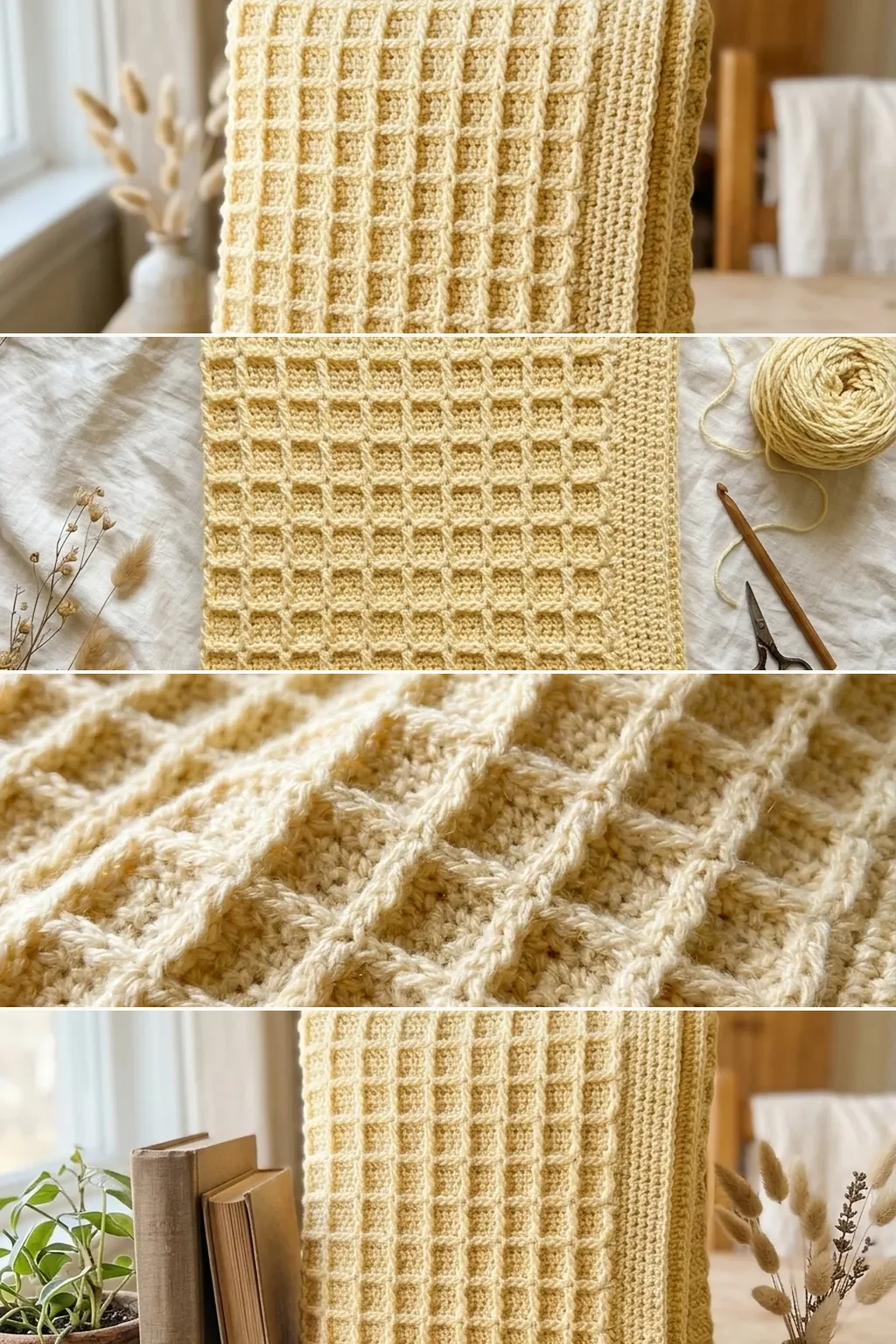
The honeycomb waffle is a textured stitch that raises a grid of cells off the surface, which is as close to a honeycomb as crochet gets without any colourwork.
It is built from ordinary double crochet alternating with front post double crochet — stitches worked around the body of the stitch below rather than into its top. The post stitches stand forward; the plain ones recede; and where the raised columns cross the raised rows, you get cells.
The foundation is a multiple of 6 plus 1. That multiple is not negotiable — the cell repeat consumes six stitches and the extra one closes the row. Count twice before row one, marking every thirty chains, because on a 36-inch blanket you are counting past a hundred and fifty.
If front post stitches are new, work a dozen on a scrap first. It is the same motion used to raise the columns on the alpine stitch, and it is the one movement in either fabric that your hands have not already done a thousand times.
Why a closed fabric
Published guidance for baby blankets consistently favours closed stitches — single, half double and double crochet — over open lacework, and the reason is practical rather than aesthetic. An open fabric has holes a finger or a toe can go through, and a baby who gets a toe through a granny-square hole will pull until something gives.
Honeycomb is dense by construction. There are no gaps anywhere in it, which is the main reason to choose it for this over anything lacy.
Gauge: Hitting a Target Size
A blanket is the one project where gauge has no fit consequence and total control over the outcome, because the size is the whole specification.
- Work a swatch at least 6 inches square in the exact yarn and hook.
- Wash and dry it the way the blanket will be washed. Not just blocked — washed, because that is what will happen to it.
- Measure the washed swatch and work out stitches per inch.
- Multiply by your target width, then round to the nearest multiple of 6 plus 1.
That rounding step is where people go wrong. If the arithmetic gives 148 stitches, your options are 145 or 151 — not 148. Pick whichever is closer and accept the half inch.
Washing the swatch rather than blocking it matters here more than on a garment. A baby blanket gets washed weekly for two years, and a fabric that relaxes two inches on its first wash will do it whether you planned for it or not.
The Buttercream and Bee Colour Plan
Buttercream is a pale, slightly warm yellow — not a bright one. At this scale a saturated yellow is overwhelming, and it is the shade most likely to clash with whatever else is in the room.
Three ways to bring the bee in without appliqués:
Banded ends. Four rows of soft charcoal at each end of the blanket, with the buttercream between. Reads as a bee without being literal, and it is the simplest.
Alternating cell rows. The honeycomb worked with every third row of cells in a deeper honey gold. Published tutorials for this stitch note it can be worked in two or more colours, and changing on the plain rows keeps each cell a single shade.
Honey ombre. Pale buttercream at one end running to deep honey at the other across four or five shades. The most striking and the one that needs the most planning — lay the skeins out in order before starting.
Keep charcoal to an accent. A blanket half in dark grey stops reading as buttercream at all.
If You Do Want Bee Motifs
Appliqués on a baby blanket are a judgment call rather than a prohibition, and one rule covers it: anything sewn on must be stitched down along its entire edge, never tacked at a point, and never glued. Glue fails in the wash and gives no warning.
Crochet the bee as a small oval with charcoal bands, sew it flat to the surface with matching sewing thread all the way round, and skip the wings — a wing is a flap, and a flap is something to pull. Embroider them instead if you want them.
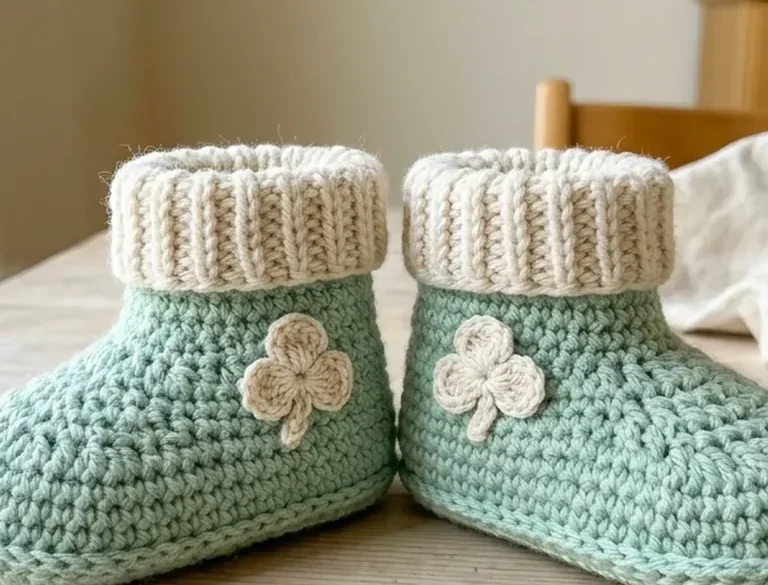
No buttons, no beads, no safety eyes on anything for a baby. The same rule governs a pair of mint clover baby booties and for the same reason: a baby pulls at whatever is nearest, and a blanket is always nearest.
Joining a New Skein
A 36-inch blanket takes five or six skeins, so you will join at least four times, and on a baby item how you join matters.
Do not knot. A knot inside a blanket is a hard lump a baby can feel through the fabric, it works its way to the surface with washing, and once it surfaces it is a loose end. Every published guide on baby items says the same: no knots, ends woven securely.
Join at the end of a row rather than mid-row wherever you can. Drop the old yarn with a six-inch tail, start the new one, and weave both ends into the side edge where the border will later cover them. A mid-row join is visible on a plain fabric and awkward to hide on a textured one.
If you must join mid-row, do it on a plain stitch rather than a front post stitch — a post stitch carries more tension and a join inside one shows as a loose spot.
Check each new skein against the one before it in daylight before working with it. A dye lot change on buttercream is subtle in a shop and obvious across three feet of finished blanket, and the only remedy once it is worked in is to alternate rows from two skeins for several rows to blur the transition.
Keeping Count Over a Long Project
A blanket is many hours of the same rows, and the errors that hurt most are the slow ones — a stitch lost every twentieth row gives a blanket noticeably narrower at the top than the bottom, and by the time it is visible it is thirty rows back.
Count every tenth row against your starting number. Not every row, which nobody sustains, and not never, which is the usual alternative. Ten rows is close enough that a correction costs twenty minutes.
Watch the turning chain. It is where blanket stitches go missing — worked into on one row and skipped on the next, which loses one stitch per row end. Decide how you treat it on row two and treat it the same way every row after.
Stop at the end of a row. Picking a textured fabric back up mid-row means working out whether the next stitch is a post or a plain one, and getting that wrong puts the whole cell grid out of alignment from there upward.
A row tally on paper beats trying to remember. Mark a stroke per row and the count is there whenever you come back to it, which on a project spread over three weeks it will not be otherwise.
The Border
A textured blanket needs an edge or the sides pull in and the corners curl.
- Foundation round: single crochet all the way round. One stitch into each stitch along the top and bottom, two into the end of every row along the sides, and three into each corner.
- Two or three more rounds of single crochet or half double crochet, keeping three stitches in each corner so it stays square.
- Optional picot round: sc, sc, chain 3, slip stitch into the first of those chains, repeated.
The two-to-one ratio along the row ends is what keeps the sides straight. One stitch per row pulls the blanket in; three makes the edges ruffle.
Keep the border shallow — three or four rounds. A deep decorative edge on a baby blanket adds weight at the perimeter, which is where a blanket is held and dragged.
Weaving In Ends, Properly
This gets a section because on a baby item it is a safety step rather than a tidiness one.
Every published guide on baby blankets says the same thing: weave in all ends securely. A tail that works loose becomes a loop, and a loop around a finger or a toe tightens.
Weave each end along a stitch line for at least two inches, then double back on itself for one more in the opposite direction. The reversal is what locks it — a tail woven in one direction slides back out with washing.
Do them as you go rather than saving them for the end. A 36-inch blanket with twenty colour changes has forty ends, and nobody weaves forty ends well in one sitting.
Making It as a Gift
Most baby blankets are made for someone else, and a few things make the difference between one that gets used and one that gets admired and put away.
Wash it before it leaves you. It softens the fabric, it removes the smell of the house it was made in, and it confirms the blanket survives a wash before that becomes someone else’s discovery.
Put the care instructions on the tag, in plain words rather than symbols. What it is made of, that it is machine washable cool, and that it is for pram and tummy time rather than the cot. Those three lines answer everything a new parent would otherwise have to guess.
Give it before the birth rather than after. A blanket that arrives in the first fortnight is one more thing to deal with in a week of too many things; one that arrives beforehand goes into the bag for the hospital.
If you are making several, work them one at a time to completion rather than running them in parallel. Blankets are long enough that a half-finished second one tends to stay half-finished.
15 Buttercream Honeybee Blanket Ideas
1. Classic Buttercream Honeycomb
The version above — a single pale buttercream throughout, letting the texture carry it.
One colour is the strongest version. The honeycomb grid is already a pattern.
Confident beginner · 17 hours · 850 yds
2. Charcoal Banded Ends
Four rows of soft charcoal at each end. The bee reference without a single motif.
Match the band depth at both ends exactly. An uneven pair looks like you ran out.
Confident beginner · 17 hours · 850 yds
3. Honey Ombre
Buttercream running to deep honey across four shades down the length.
Lay the skeins out in order and photograph them before starting. Mid-blanket is a bad time to discover two shades are too close.
Confident beginner · 18 hours · 900 yds
4. Lovey Size
A 12-inch square with a knotted corner for holding. Three hours and the one most likely to be used daily.
Work the border tighter than on a big blanket. A lovey gets chewed and the edge takes the worst of it.
Beginner · 3 hours · 150 yds
5. Pram Size in Cotton
30 by 36 inches in machine-washable cotton, for warmer months and easy washing.
Cotton has no stretch, so count rather than measure as you go.
Confident beginner · 14 hours · 700 yds
6. Two-Tone Cells
Every third row of cells in deeper honey gold, the rest buttercream.
Change colour on the plain rows so no individual cell is split between two shades.
Confident beginner · 17 hours · 850 yds
7. Play Mat
40 inches square and worked at a tighter gauge, so it holds its shape on a floor.
Go down half a hook size. A floor blanket gets crawled on and a loose fabric rucks.
Confident beginner · 21 hours · 1,050 yds
8. Sage and Cream Version
The same fabric in soft sage with a cream border, for a nursery that is not yellow.
Keep the border pale. A dark border on a muted blanket frames it too heavily.
Confident beginner · 17 hours · 850 yds
9. Matching Lovey and Blanket Set
A full blanket plus a 12-inch lovey from the same yarn, boxed together.
Make the lovey from what is left after the blanket, not before. You will know the exact quantity.
Confident beginner · 20 hours · 1,000 yds
10. Embroidered Bee Corner
A single small bee embroidered into one corner in charcoal and gold, with nothing sewn on at all.
Embroider through the surface stitches only, not through the whole fabric, so the back stays flat.
Confident beginner · 18 hours · 850 yds
11. Scalloped Edge
A shell border instead of picot, for a softer outline.
Keep it to one round. A deep shell edge on a heavy blanket droops.
Confident beginner · 18 hours · 880 yds
12. Wider Cells
The same construction with the repeat spread wider, giving larger, flatter cells.
Recalculate the multiple before chaining. A different repeat is a different multiple.
Confident beginner · 16 hours · 800 yds
13. Chunky Quick Version
Aran weight on a 6.0 mm hook, finished in half the time.
Use this for a pram cover rather than wrapping. A thick blanket can overheat a wrapped baby.
Confident beginner · 9 hours · 600 yds
14. Twin Set
Two identical blankets in slightly different shades, for twins.
Work them together, alternating a few rows at a time, so the tension matches across both.
Confident beginner · 34 hours · 1,700 yds
15. Keepsake With a Woven Label
A plain buttercream blanket with a small fabric label stitched into the border seam.
Stitch the label into the border as you work it, not sewn on afterward. Nothing on the surface.
Confident beginner · 17 hours · 850 yds
Common Problems and Fixes
The blanket is narrower at the top than the bottom
Stitches lost at the row ends, usually the turning chain. Count every tenth row against your starting number — on a blanket this is the error that compounds furthest before anyone notices.
The sides pull in
The border used one stitch per row end instead of two. Take the border out and redo the foundation round at two-to-one.
The corners curl
Not enough stitches in the corner. Three single crochet into each corner on every round, not two.
The cells look flat
The front post stitches are worked too tightly, or the hook is too small. Post stitches need a little slack to stand forward.
It came out much smaller after washing
The swatch was blocked but not washed. Wash the swatch the way the blanket will be washed, and measure that.
The repeat runs out at the end of the row
The foundation is not a multiple of 6 plus 1. There is no fix but to redo the chain, which is why it gets counted twice.
The ends keep working loose
Woven in one direction only. Go two inches along a stitch line, then double back one inch the other way.
Washing and Keeping It
Machine wash cool on a gentle cycle, in a mesh bag if the border has picots that can catch. Tumble dry low or dry flat; a blanket hung wet stretches at the pegged corners and does not fully recover.
Wash it before gifting. It softens the fabric noticeably, it removes any trace of the house it was made in, and it tells you the blanket survives a wash before it becomes someone else’s problem.
Check the border and any embroidery each time it comes out of the wash. That is the whole maintenance task.
Frequently Asked Questions
What size should a crochet baby blanket be?
It depends on use: around 12 inches square for a lovey, 30 by 36 for a pram, 36 inches square for receiving and wrapping, 40 inches square for a play mat.
How much yarn does a baby blanket take?
Roughly 850 yards of DK for a 36-inch square in this textured stitch. Honeycomb uses noticeably more than plain double crochet, so buy a skein more than you calculate.
Is a crochet blanket safe in a crib?
Safe-sleep guidance is to keep loose blankets out of a baby’s sleep space. Make this as a pram, tummy-time and wrapping blanket used with an adult present, and say so on the gift tag.
What is the stitch multiple?
A multiple of 6 plus 1. The cell repeat uses six stitches and the extra one closes the row.
What yarn is best for a baby blanket?
Machine washable above all. Sources disagree on fibre — some favour acrylic for durability, others avoid it for heat retention. Weight matters more: DK or sport rather than chunky, because a thick blanket can overheat a wrapped baby whatever it is made from.
Why a closed stitch rather than lace?
Open fabric has holes a finger or toe can go through. Closed stitches are the standard recommendation for baby blankets for exactly that reason.
Can I add crocheted bees?
Yes, if they are sewn down along their entire edge with thread and have no wings, buttons or beads. Never glued. Embroidery is the safer option.
How do I stop the sides pulling in?
Two single crochet into the end of each row on the border’s foundation round, and three in each corner.
Should I block it?
Wash it rather than block it, and measure from that. A baby blanket is washed constantly and that is the state it lives in.
How long does one take?
About 17 hours for a 36-inch square. A lovey takes three.
Final Thoughts
Decide the use before the size and everything else follows. A pram blanket, a wrapping blanket and a play mat are three different objects, and the one that gets used daily is the one that matched how the family actually lives.
Then wash your swatch. It is the single step that separates a blanket that finishes at the size you meant from one that comes back from its first wash two inches narrower — and on a project this long, that is a lot of hours riding on a six-inch square.