 Clara•🕑 October 26, 2026•💬 No comments
A motif cardigan is built from one decision repeated: get the square right and the garment is arithmetic. Get it wrong and you find out forty squares later, which is why almost everything below is about the square.
The sunflower is a good one to build with. It is four rounds, it finishes around six inches, and its petals are puff stitches — which means the texture comes from the stitch rather than from anything sewn on afterwards.
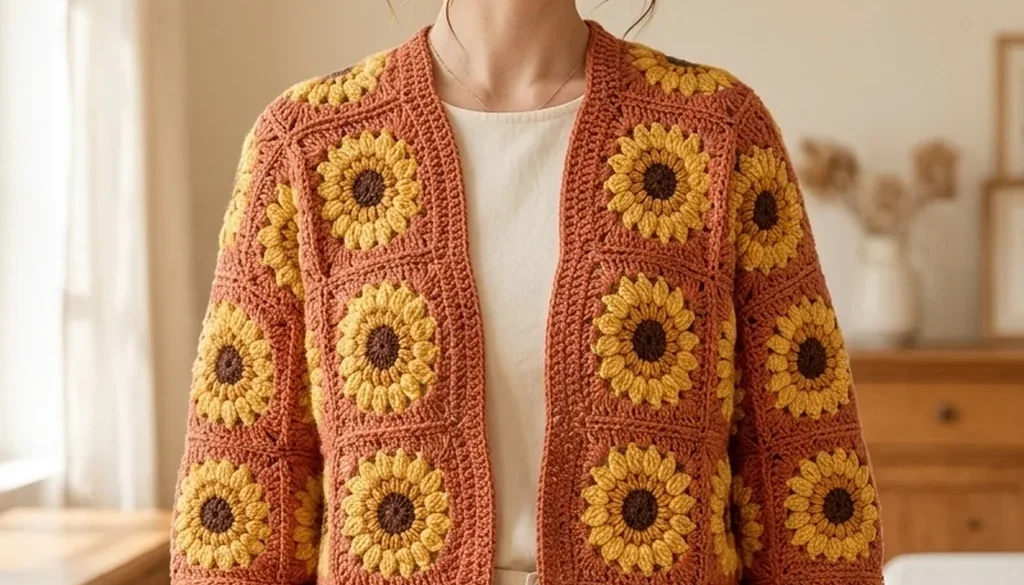
This is the terracotta sunflower cardigan crochet pattern approached from the motif outward: the square round by round, then how many of them make a cardigan.
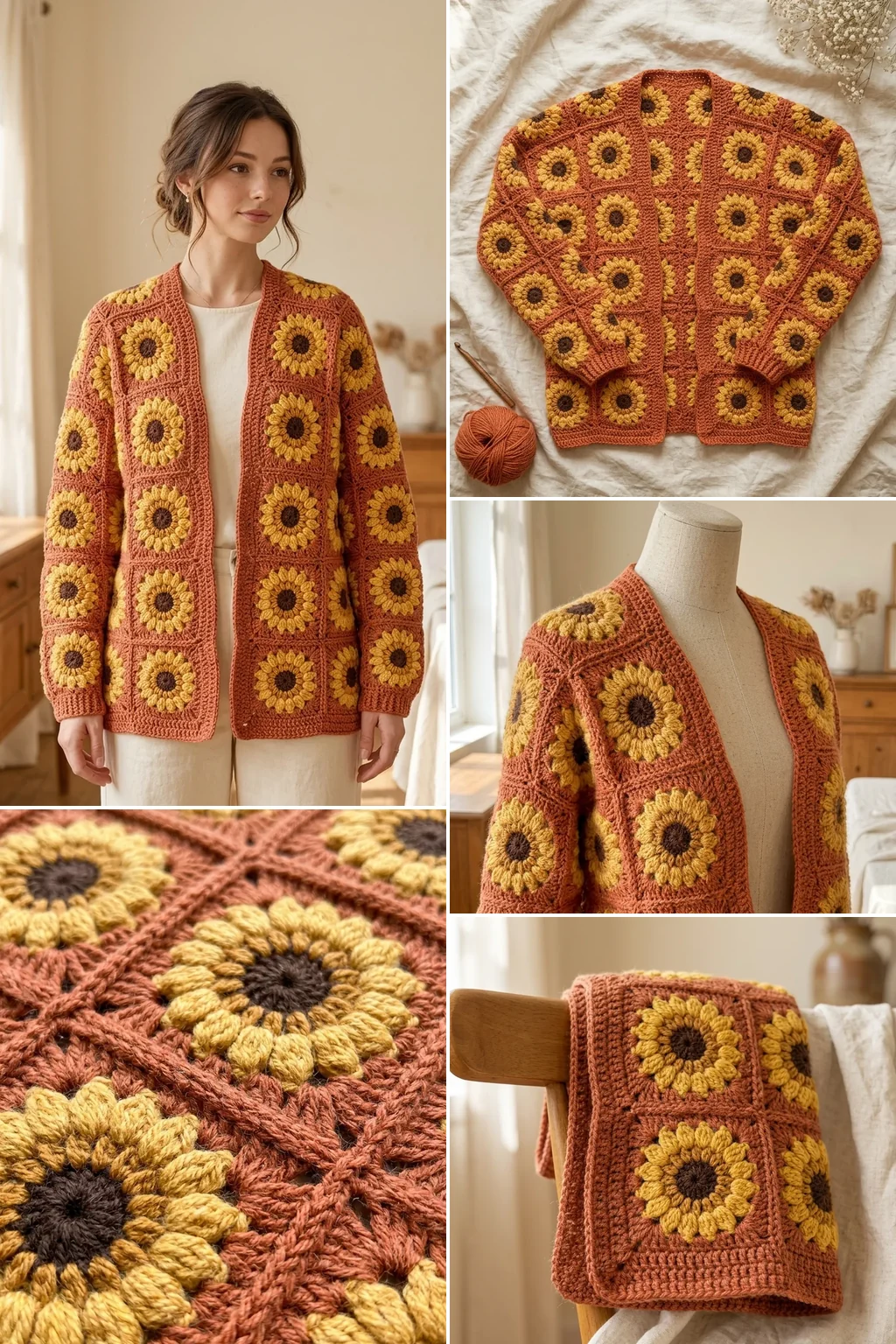
Sunflower Square at a Glance
| Skill level | Advanced beginner — puff stitches, joining |
| Rounds | Four |
| Finished square | 6.1–6.5 in |
| Yarn | Worsted, three colours |
| Squares per cardigan | 28–40 by size |
| Time | 20 min a square |
The Seed Centre
The centre is a flat circle worked in the darkest colour, and it has to lie flat on a table with no help — a cupped centre pulls the whole square into a dome and no amount of blocking fixes it once forty of them are joined.
- Magic loop. Chain 1 as a standing stitch, work 6 single crochet into the loop, slip stitch to the first.
- Round 2: 2 single crochet into each stitch. (12)
- Round 3: 1 single crochet, then 2 into the next, repeated. (18)
Three rounds of seed centre is the usual depth. Add a fourth increase round if you want a larger flower, but add it to every square — a cardigan with two centre sizes reads as a mistake.
Use a magic loop rather than a chain ring. A chain ring leaves a hole in the middle of the flower, and on a sunflower the centre is the first thing the eye lands on.
The Puff Petals
The petals are what make this a sunflower rather than a circle in a square, and they are puff stitches rather than separate pieces.
A petal is a six-half-double-crochet puff worked over two stitches of the centre, with chains between each petal. Yarn over, insert the hook, draw up a loop, and repeat until thirteen loops sit on the hook, then close them all at once. Spanning two stitches rather than one is what gives the petal its width.
Chain one or two between petals. The chain is the gap the next round anchors into, and without it the petals crowd and the square will not lie flat.
Work the petals in the main petal colour and the round after in the background. Changing colour on the join rather than after it keeps the boundary clean.
Puffs are tiring on the hands at this count. Thirteen loops is a lot to pull through, and the yarn matters more than usual — a smooth yarn slides, a grabby one fights you on every petal. If you find them hard work, a popcorn stitch gives similar texture with less strain.
Squaring It Off
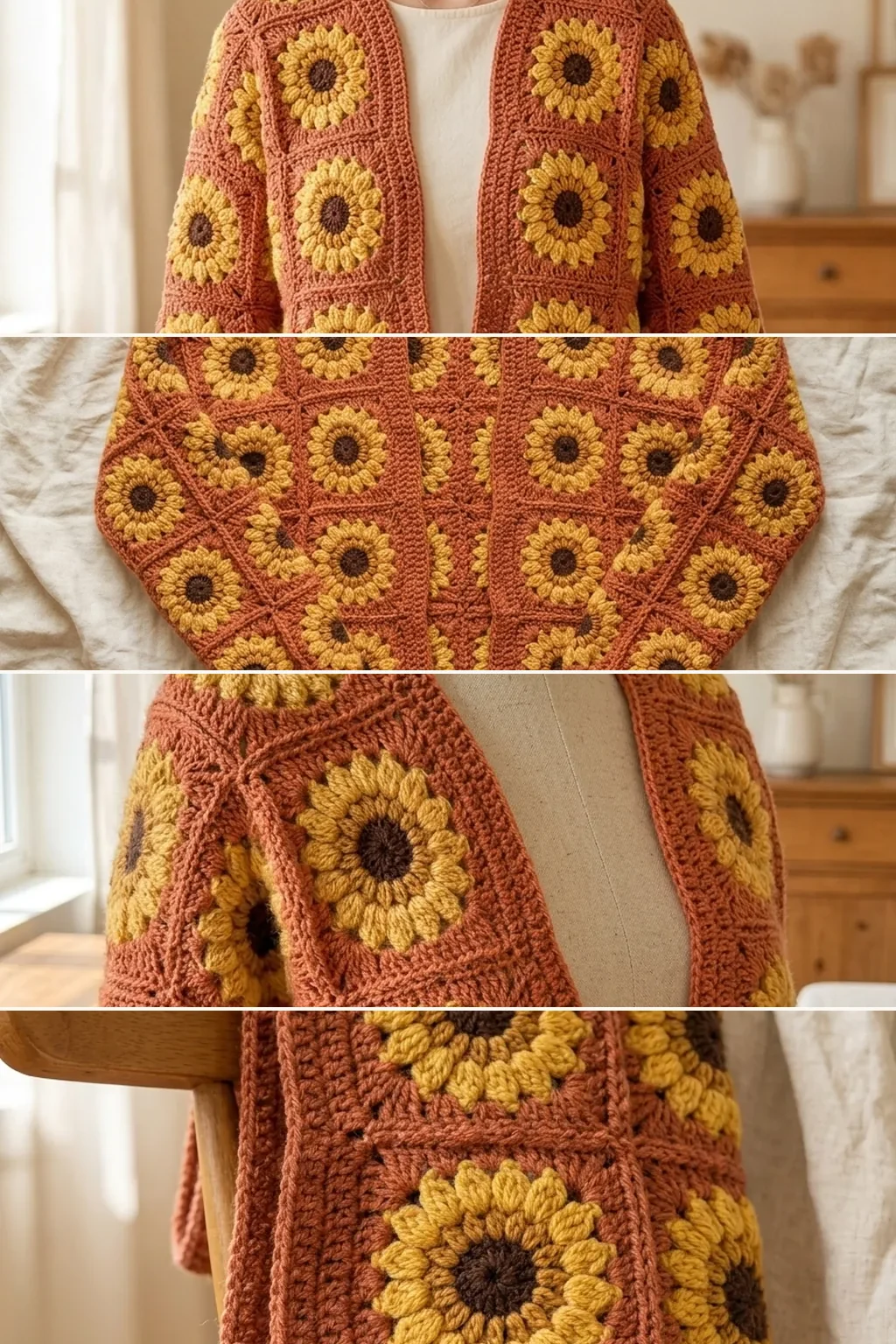
The final round turns the circle into a square by putting most of the stitches in the corners and few along the sides.
Work into the chain spaces between the petals, with a cluster of stitches at each of the four corner positions and a shorter run between them. The exact counts vary between patterns — what matters is that the four corners are evenly spaced around the flower and that the sides come out the same length.
Measure the first finished square before making any more. Published sunflower squares of this construction land around 6.1 to 6.5 inches across four rounds. If yours is seven, every garment measurement below shifts, and it is far better to change hook now than to find out at square thirty.
The Square Is the Unit
On a motif garment, gauge is not stitches per inch. It is the square.
Once you know your square’s width, the cardigan is division. A 36-inch bust needs six squares around at 6 inches each; at 6.5 inches, five and a half — so you either go to six and accept a slightly roomier fit, or change hook to bring the square down.
| Size | Bust | Squares around | Rows deep | Total squares |
|---|---|---|---|---|
| S | 34–36 in | 6 | 4 | 28 |
| M | 38–40 in | 6 | 5 | 32 |
| L | 42–44 in | 7 | 5 | 36 |
| XL | 46–48 in | 8 | 5 | 40 |
Those totals include the sleeves. A motif cardigan has no shaping, so a square either fits in the layout or it does not — which is the trade for never having to decrease around an armhole.
Laying Out the Cardigan
The build order that works is squares first, then columns, then panels.
- Make every square and block them all.
- Join into columns the depth of the garment.
- Assemble two fronts and a back from those columns.
- Join the shoulders, then the sleeves, then seam the sides.
- Work a border around the fronts and neck last.
Making all the squares before joining any is worth the discipline. Tension drifts across an evening, and a cardigan assembled as you go puts your tightest squares and your loosest ones wherever they happened to fall rather than where they are least visible.
Block before joining, not after. Blocked squares are the same size as each other, and squares that are the same size join without easing. It is the step that saves the most time overall while feeling like the one that wastes it.
Joining
Three methods, and they give visibly different garments.
Whip stitch — the fastest, and nearly invisible from the front. Best when you want the flowers to read as a continuous field.
Slip stitch — flat, with no ridge on either face, worked with a hook rather than a needle.
Single crochet — leaves a deliberate ridge on the surface, which turns the grid into part of the design. Choose it only if you want the lattice visible.
Join as you go — joins each square on its final round, which removes the finishing stage almost entirely. The catch is that it commits you to the layout before you have seen all the squares together.
Whichever you pick, use it everywhere. Mixed joins on one garment show at the shoulder seams where the light changes.
The Three Colours
A sunflower needs a dark centre, a bright petal and a background, and the background is the one that decides whether the cardigan is wearable.
Terracotta as the background rather than the petals. A field of bright yellow squares is a costume; terracotta squares with yellow flowers inside them is a garment. The background colour is roughly two thirds of the fabric, so it is the colour people will say the cardigan is.
Deep brown or charcoal for the seed centre. Not black — black against terracotta reads as a hole at arm’s length, and the centre is small enough that it disappears entirely.
Golden yellow for the petals, a shade warmer than lemon. A cool yellow fights terracotta; a warm one sits inside it.
Buy the background in one dye lot and buy generously. It is two thirds of the yarn and the one colour where a lot change shows, because it runs continuously across every square and every join.
Yarn and Hook
Worsted weight on the hook the band recommends. Puff stitches need the fabric around them to be firm — on a loose fabric the petals flatten into the square instead of standing off it.
Smooth yarn, strongly. A thirteen-loop puff is hard enough to close without the yarn catching on itself, and a grabby or fluffy yarn turns each petal into a fight. Wool and wool blends have the best combination of glide and memory; acrylic works and is easier to wash, which on a cardigan of this size matters.
Avoid anything variegated. The square already has three colours doing specific jobs, and a fourth that changes mid-petal muddles all of them.
Common Mistakes
The square domes instead of lying flat
The seed centre has too few stitches for its rounds, or the petal round is too tight. The centre must lie flat on a table before the petals go on — check it then, not later.
The square ripples at the edges
The opposite: too many stitches in the final round. Take some out of the side runs rather than the corners, which need their count to stay square.
Petals crowd together
No chains between them. The chain space is both the gap and the anchor for the next round.
The squares are different sizes
Tension drift, and it is normal. Block them all together on one mat and the difference largely disappears — this is the main reason to block before joining.
The cardigan is wider than planned
The square measured bigger than 6.5 inches and the count was kept. Squares multiply: a quarter inch over on six squares is an inch and a half on the bust.
The shoulders droop
A motif garment has no shoulder shaping, and a heavy worsted cardigan pulls down. Join the shoulder seams firmly with whip stitch, never a loose slip stitch.
Frequently Asked Questions
How big should the sunflower square be?
Around 6.1 to 6.5 inches across four rounds in worsted. Measure your first one and size the cardigan from that figure rather than from a pattern’s.
How many squares does a cardigan take?
28 for a small, up to 40 for an extra large, including sleeves.
What makes the petals?
Six-half-double-crochet puffs worked over two stitches of the centre, separated by chains. Spanning two stitches is what gives each petal its width.
Why use a magic loop for the centre?
It closes completely. A chain ring leaves a hole in the middle of the flower, which is the first place anyone looks on a sunflower.
Do I have to block the squares?
Before joining, yes. Blocked squares are consistent with each other, and consistent squares join without easing.
Which join should I use?
Whip stitch for an invisible seam, single crochet if you want a visible lattice, join-as-you-go to skip the finishing stage. Use one method throughout.
Can a beginner make this?
The square is advanced beginner — the puff is the only demanding part. The cardigan is assembly rather than shaping, so there is nothing harder than the square itself.
Can I use a different motif?
Yes, as long as it squares off at the same size. The layout above works for any six-inch square, including a plain granny.
Final Thoughts
Make one square, block it and measure it before making a second. That measurement is the only number in the whole project, and every garment dimension comes out of it.
Then make all of them before joining anything. The same discipline makes a blush butterfly cardigan sit flat — motifs finished and blocked first, assembled second — and if the puff stitches wear on your hands, the bobble stitch is the same family of cluster texture worked with fewer loops on the hook.