 Clara•🕑 October 8, 2026•💬 No comments
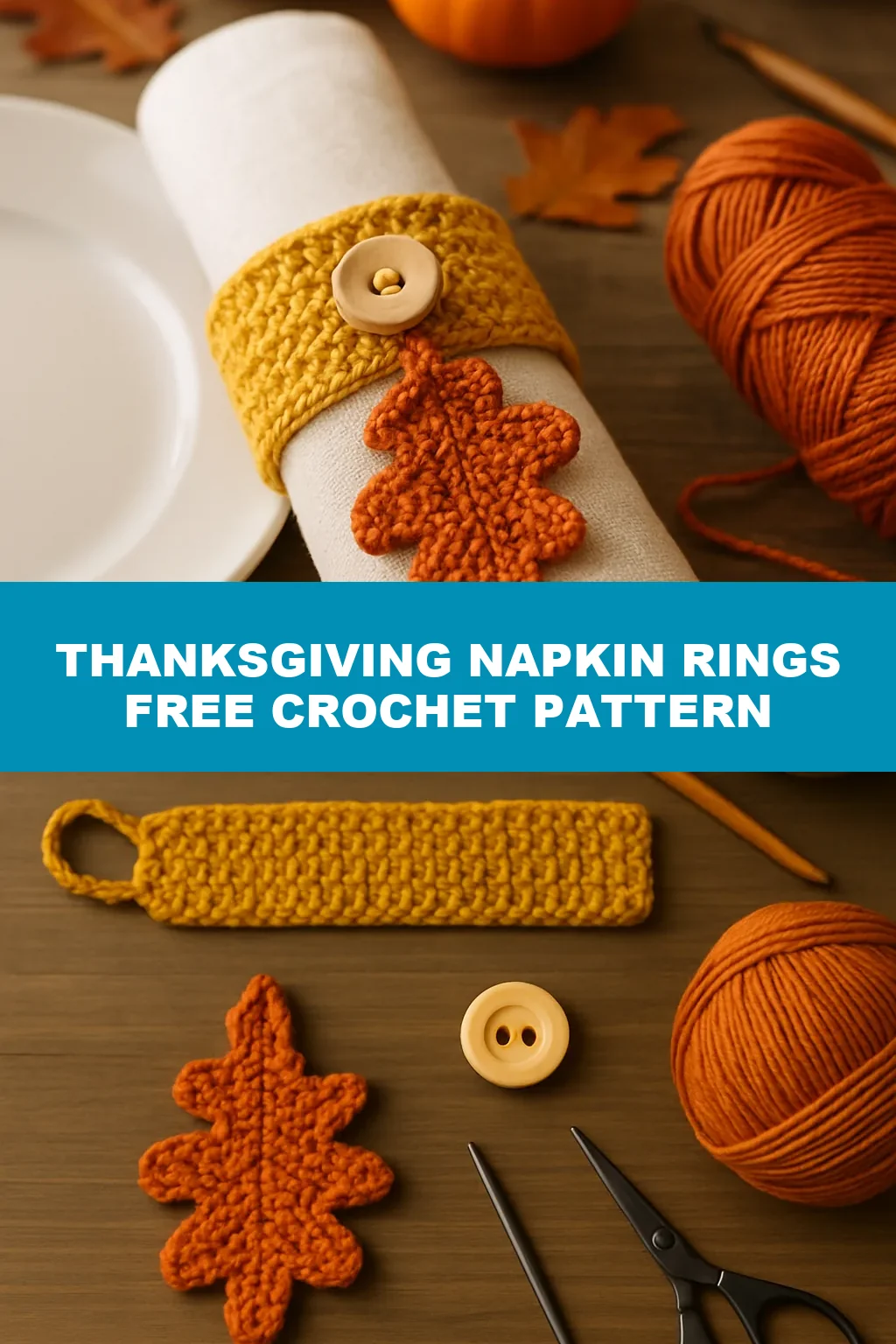
Crochet Thanksgiving napkin rings are the smallest project on the holiday table and the one guests pick up first, which is why a ring that slides off a napkin or a leaf that flops face-down is so noticeable. You set the table on Thursday morning, roll the napkins, and the paper bands from the store look exactly like what they are. This guide shows you how a crocheted napkin ring is built, how to size the band so it grips, how to attach a motif so it stays upright, and 9 Thanksgiving napkin ring ideas you can start this week. Follow the sizing table before you make the full set and every ring will fit the first time.
Crochet Thanksgiving Napkin Rings at a Glance
- Skill level: beginner for a plain band, easy to intermediate with a leaf or motif
- Time: about 45 minutes for a band, about an hour with a leaf
- Yarn: worsted weight cotton, small amounts, scraps welcome
- Hook:
4 mmto5 mmfor worsted weight - Closure: a chain loop and a
3/4 into1 inwooden button - Start by: early November for a set of eight
Crochet Abbreviations Used Here
Every instruction on this page uses US crochet terms. If you learned from a UK pattern, your “double crochet” is the US single crochet, so check the table before you start.
| Abbreviation | US term | UK equivalent |
|---|---|---|
| ch | chain | chain |
| sl st | slip stitch | slip stitch |
| sc | single crochet | double crochet |
| hdc | half double crochet | half treble |
| dc | double crochet | treble |
| sk | skip | miss |
| st(s) | stitch(es) | stitch(es) |
How a Crochet Napkin Ring Is Built
Every crocheted napkin ring, however it is decorated, comes down to three parts: a band, a closure and a motif. Get the first two right and the third is decoration. Get them wrong and the prettiest leaf in the world sits on a ring that slips off the napkin before the turkey is carved.
The band
The band is a short strip of single crochet worked in rows. Single crochet is the densest of the basic stitches, so it gives a firm fabric that grips the napkin rather than stretching around it. Taller stitches such as double crochet open up and sag, which is why almost every napkin ring pattern you will find uses single crochet or a single crochet variation like moss stitch.
Width is a design choice. A narrow band of 4 stitches comes out about 1 in wide in worsted weight and suits a single leaf. A wider band of 9 stitches is closer to 2 in and gives a bigger motif room to sit. Length is not a choice: it is set by the napkin, and the sizing table below gives you the numbers.
The closure
A closed loop of crochet looks neat but has a problem: it fits one napkin thickness only. A button closure fixes that, because you can move the button to tighten or loosen the ring. The usual method starts the band with a ring of chains that slips over a button sewn near the other end. The overlap where the two ends meet also hides the shaping at the start of the band.
A two-button version uses chain-space loops worked into the last row instead. It holds more securely on a thick linen napkin and suits a wider band.
The motif
The motif carries the Thanksgiving theme, usually as a leaf, a pumpkin, a turkey or an acorn. It is worked separately and sewn on, which means you can make a stack of motifs while watching television and attach them all in one session. Keep motifs flat and light. A heavy motif drags the ring around so it faces the plate, and you spend the meal turning it back.
Step-by-Step: The Autumn Oak Leaf Napkin Ring
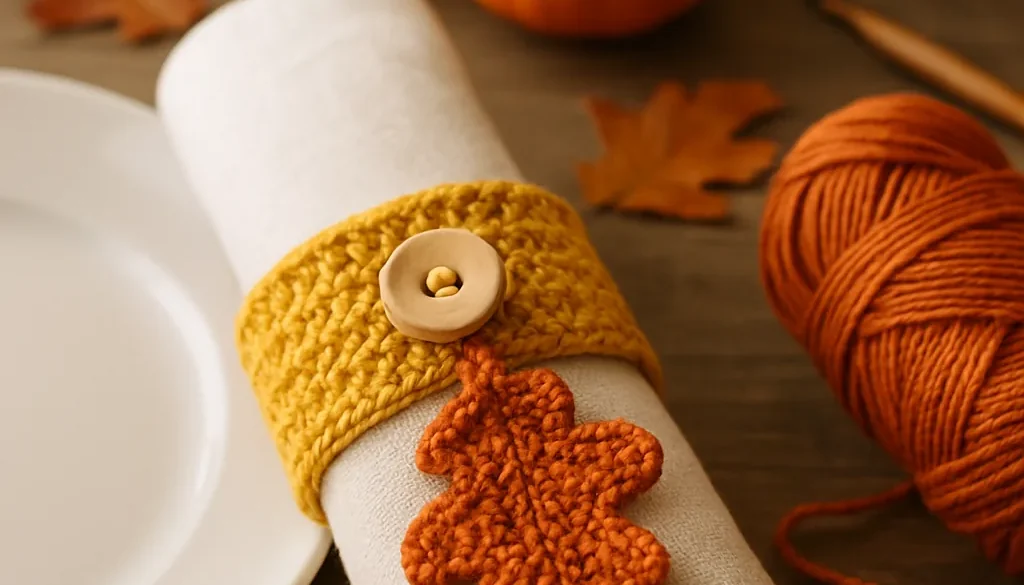
This is the ring in the photos: a mustard band with a button loop at one end and a burnt-orange oak leaf sewn opposite the button. The base and leaf follow the free Creativebug autumn leaf napkin ring pattern, which you should keep open for the full lobe round of the leaf. You need worsted weight yarn in two colours, a 5 mm (H-8) hook, a 3/4 in or 1 in wooden button, scissors and a tapestry needle.
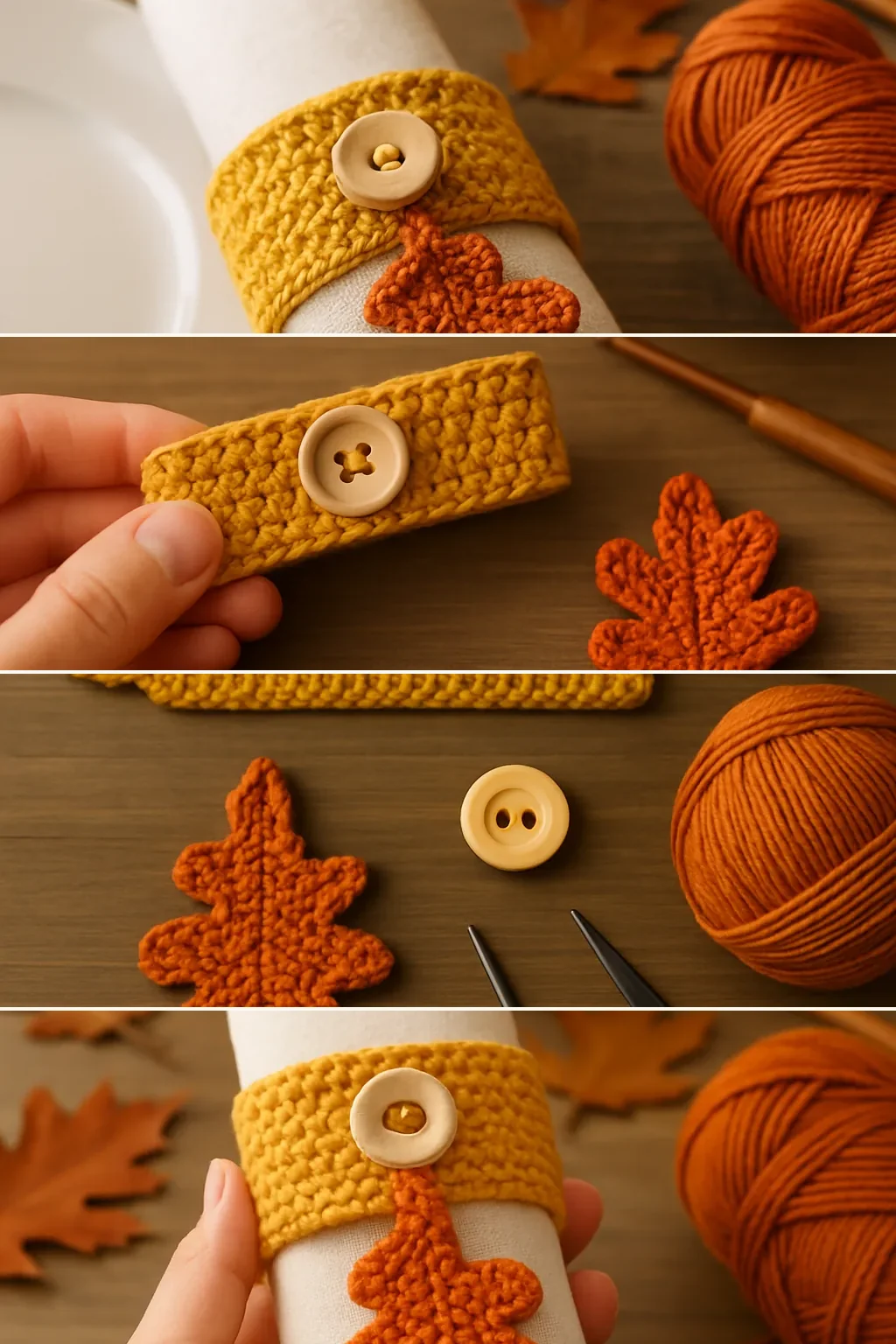
- Make the button loop. Ch 8, then sl st into the first ch to close it into a ring. Slip it over your button before you go further. It should pass over easily without gaping, so add or remove chains until it does.
- Row 1. Ch 1, then work 1 sc into the ring.
1 st - Row 2. Ch 1, turn, and work 2 sc into the single sc.
2 sts - Row 3. Ch 1, turn, work 2 sc into the first st and 1 sc into the next.
3 sts - Row 4. Ch 1, turn, and work 2 sc into each of the 2 sts.
4 sts - Rows 5 to 29. Ch 1, turn, and work 1 sc into each st across.
4 stsper row. Measure as you go: the straight part from Row 5 to Row 29 should reach about5 1/4 into5 1/2 in. For a wider 2 in ring, keep going until it reaches about6 in. - Finish the band. Fasten off and weave in both ends.
- Start the leaf. With the leaf colour, ch 10.
- Leaf Round 1. Skip the first ch from the hook. Work 6 sc, then 2 hdc into the next chains, then 6 dc into the last ch. Turn the work and continue down the other side of the foundation chain with 2 hdc and 6 sc. Sl st into the first sc to join.
22 sts - Leaf Round 2. Work the scalloped lobe round from the Creativebug pattern, which builds each lobe from hdc, dc and short chain loops anchored with slip stitches. The leaf will ruffle a little because of the number of stitches in this round, and that is expected.
- Add the stem. Ch 4, skip the first ch from the hook, work 3 sl sts back along the chain, then sl st into the first hdc of Round 1. Fasten off, weave in the ends, and press the leaf flat with your hands.
- Sew on the button. Place it about 3 rows, or roughly
3/4 in, in from the straight end of the band. - Attach the leaf. Button the ring and centre the button. Find the middle of the side opposite the button, which is easiest with the ring on a rolled napkin. Sew the leaf on with matching yarn in a small rectangle, catching only 1 or 2 strands at the back of the leaf so nothing shows on the front.
The leaf takes longer than the band, so batch them. Make every band in one sitting, every leaf in the next, and sew them all together at the end. The rings in a set then come out matching, because your tension stays the same across a session.
Sizing: Band Length for Every Napkin
A ring that slips off is almost always a band that is too long, and a ring you cannot close is a band worked too tightly. Roll the napkin you will actually use, wrap a tape measure around it, and add the overlap for the button. Then check your band against this table.
| Ring opening | Napkin it suits | Circumference | Band length with overlap |
|---|---|---|---|
| 1.5 in | Thin cotton, folded small | about 4 3/4 in | about 5 1/2 in |
| 1.75 in | Standard cotton or polyester | about 5 1/2 in | about 6 1/4 in |
| 2 in | Heavy linen, rolled | about 6 1/4 in | about 7 in |
| 2.5 in | Napkin plus flatware | about 7 3/4 in | about 8 1/2 in |
The circumference figures come from multiplying the opening by pi, and the overlap adds about 3/4 in so the button sits on a double layer. Crochet stretches a little with use, so if you fall between two rows, choose the shorter band.
Make one ring, put it on a napkin, and leave it overnight before you make the rest. If it has loosened by morning, take two rows off the pattern for the full set. This one test saves you from discovering on Thursday that eight rings all slide off.
Timing and Planning a Full Set
Napkin rings look quick until you multiply by the number of guests. One ring is an evening’s work. Twelve rings with leaves are a project, and Thanksgiving week is the worst time to discover how much time a project takes.
| Set size | Plain bands | Bands with a leaf | Start by |
|---|---|---|---|
| 4 places | about 3 hours | about 4 hours | 2 weeks before |
| 6 places | about 4.5 hours | about 6 hours | 3 weeks before |
| 8 places | about 6 hours | about 8 hours | 3 to 4 weeks before |
| 12 places | about 9 hours | about 12 hours | early November or sooner |
These times are rough and assume one ring at a time. Work in batches and you will beat them. Make one or two spares for a late guest or a ring that ends up under the table.
Buy all the yarn for the set in one go and check the dye lot on every ball. Two mustard balls from different lots look identical in the shop and different side by side on a white tablecloth.
Colour Palettes for a Thanksgiving Table
The band and motif colours should come from your tablecloth and plates rather than from a generic autumn chart. Lay a scrap of each yarn on the cloth before you buy a full ball.
| Palette | Band | Motif | Suits |
|---|---|---|---|
| Harvest gold | Mustard | Burnt orange leaf | Cream linen, white plates |
| Deep autumn | Chocolate brown | Rust or cranberry leaf | Wood table, no cloth |
| Farmhouse | Natural jute | Cream or sage leaf | Grain-sack cloth, stoneware |
| Soft neutral | Oatmeal | Blush or terracotta pumpkin | Pale linen, candles |
| Mixed leaves | Cream | Red, orange and gold leaves in rotation | A table with children |
Cotton takes colour well and keeps it through many washes, which matters on a table where gravy will find at least one napkin. Avoid very dark bands with pale napkins if your yarn sheds, because the fibres show on white linen.
Common Problems and Fixes
The ring slides off the napkin
The band is too long or too loose. Move the button one row further in, which tightens the ring by about a quarter inch without remaking anything. For the rest of the set, drop down half a hook size and work two fewer rows.
The leaf flops forward or curls around the napkin
A leaf sewn on with one line of stitches pivots forward on that line. Sew a small rectangle instead, roughly the size of your thumbnail. If the leaf curls, the patch is too wide or the stitches are pulling too hard, so loosen them.
The band edges wave
Wavy edges usually mean a stitch was added or lost at the end of a row. The turning chain is the usual culprit: the ch 1 at the start of a single crochet row does not count as a stitch, so the first sc goes into the first stitch, not the next one. Count the stitches every few rows until the habit settles.
The button loop is too tight or too loose
The chain loop is the first thing you make, so test it against the button before you work a single row. If you have finished the band already, sew on a larger or smaller button rather than ripping back.
The rings in the set do not match
Tension drifts between sessions, and the difference shows when eight rings sit in a row. Count the rows instead of measuring each ring separately, and keep the same hook for the whole set.
Gifting Notes
A set of four napkin rings is one of the best small handmade gifts for a Thanksgiving host. It costs very little yarn, it gets used every year, and it travels flat in an envelope. Tie the set together with a length of the band yarn and tuck in a note with the fibre content and washing instructions.
If you are a guest bringing them, give them a week before the meal rather than at the door. The host has set the table by the time you arrive and will not change it. The same oak leaf makes a good gift tag, too: work it on its own and tie it onto a jar of cranberry sauce.
When Thanksgiving is over, the same skills carry into December. Swap the leaf for a small star or a holly sprig and you have a Christmas set, or string a row of leaves into a crochet Christmas garland for the mantel.
9 Thanksgiving Projects to Start Now
Each idea below is a complete napkin ring you can make for this year’s table. They are listed roughly easiest first within each group, and every one uses the band and closure methods covered above.
Autumn Oak Leaf Napkin Ring
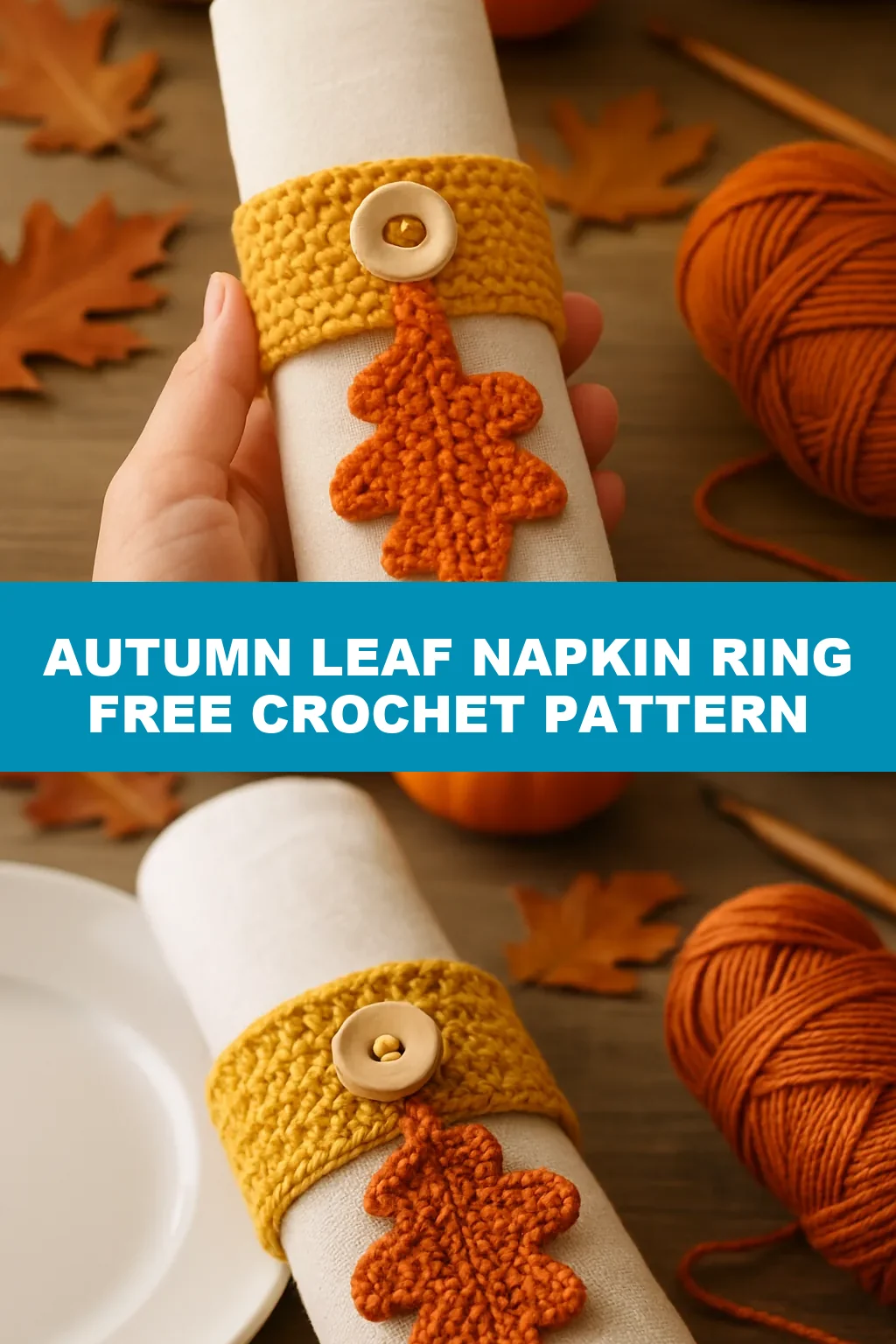
This is the ring taught step by step above: a single crochet band that buttons closed, with a scalloped oak leaf sewn opposite the button. It teaches the three skills every napkin ring needs, which are sizing a band, making a closure that holds, and attaching a motif so it stays upright. Make one in each of three leaf colours and set them around the table in rotation.
Easy · about 1 hour · worsted cotton, mustard band and burnt-orange leaf
Moss Stitch Two-Button Band
A 9-stitch band in moss stitch, alternating single crochet and chain-one spaces, with two buttons on one end and two chain loops on the other. The texture hides small tension slips, which makes it the kindest first project here, and a variegated yarn does the colour work for you. The full pattern is free at 5 Little Monsters.
Beginner · about 45 minutes · worsted weight, variegated autumn shades
Turkey Napkin Ring and Flatware Holder
A flat turkey about 4.5 in wide with a napkin ring on the back, so the napkin, knife and fork stand together at each place setting. Children at the table reach for these first, and the turkey uses up short lengths of every autumn colour in your scrap bag. A Crocheted Simplicity has a free version rated easy.
Easy · about 2 hours · worsted weight scraps in brown, red, orange and gold
Mini Pumpkin Napkin Ring
Swap the oak leaf for a small flat pumpkin, worked as a short strip of back-loop single crochet ribbing, gathered at both ends and finished with a green chain-loop stem. The ribbing teaches how working in the back loop creates vertical texture, which reads instantly as a pumpkin. Keep the pumpkin under 2 in wide so it sits on the band without hiding the napkin.
Easy · about 1.5 hours · worsted cotton in orange and green
Maple Leaf Trio Ring
Three small leaves fan out from the button side of a cream band, each in a different autumn shade. Overlapping the leaves teaches you to plan placement before you sew, because the bottom leaf has to go on first. This version works well as the ring for the head of the table, with single-leaf rings at every other place.
Intermediate · about 2 hours · worsted cotton in red, orange and gold
Felted Autumn Leaves Ring
Worked in pure wool with a 6 mm hook, then lightly felted so the stitches blur into a firm, smooth fabric about 2.5 by 4.5 in. Felting teaches you to crochet oversize on purpose and let shrinkage bring the piece down to size. Lion Brand’s set of six, listed on AllFreeCrochet, uses this approach and is rated intermediate.
Intermediate · about 2 hours plus felting · 100% wool, worsted weight
Rustic Jute Twine Band
A plain single crochet band in natural jute with a wooden toggle in place of a button suits a farmhouse table and plain linen. Jute is stiff and rough on the hands, so work it with a 6 mm hook and keep the band narrow at 4 or 5 stitches. It teaches you how fibre changes the character of the same simple stitch.
Beginner · about 45 minutes · jute twine or paper raffia
Acorn Cap Napkin Ring
A small amigurumi acorn, stuffed lightly and sewn to a tan band, with the cap worked in brown and the nut in tan. It teaches the basics of working in the round with increases and decreases on a piece that is finished in one sitting. Make the acorn no taller than 1.5 in so it does not tip the napkin over.
Intermediate · about 1.5 hours · worsted weight in tan and brown, small amount of stuffing
Cream Lace Shell Ring
A narrow lace band of shell stitches in cream or ivory cotton, for a Thanksgiving table set with white china and candles. Lace teaches you to count chain spaces precisely, because one missed space shifts every shell after it. Starch it lightly after washing so the shells hold their scallops for the whole meal.
Intermediate · about 1 hour · sport weight cotton or cotton thread
Frequently Asked Questions
How long should a crochet napkin ring band be?
Measure around a rolled napkin and add about 3/4 in for the overlap. For a typical ring of about 1.75 in across, a band of 5.25 to 5.5 in from the end of the increases works well.
What yarn is best for crochet napkin rings?
Worsted weight cotton is the best all-round choice, because it holds its shape, washes well and does not shed onto food. Wool works if you plan to felt the rings, and acrylic is fine for a rustic set that will not be washed often.
What hook size should I use for napkin rings?
Most worsted weight napkin ring patterns use a 4 mm to 5 mm hook. Go down half a size from the yarn label so the band stays firm and does not stretch around the napkin.
How many napkin rings can I make from one ball of yarn?
A plain band uses only a small amount of yarn, so one ball of worsted cotton covers a full set of bands for most tables. Weigh your first finished ring and divide the ball weight by it to know for sure before you start the set.
How do I stop the leaf from flopping forward?
Sew the leaf on with a small rectangle of stitches rather than a single line. One line lets the leaf tip forward, and a very wide patch makes the leaf curl around the napkin.
Can I wash crochet napkin rings?
Cotton rings can be hand washed or machine washed on a gentle cycle in a mesh bag, then laid flat to dry. Felted wool rings should be spot cleaned only, because another hot wash will shrink them further.
How far ahead should I start a Thanksgiving set?
Start three to four weeks before Thanksgiving for a set of eight. Each ring with a leaf takes about an hour, and the leaves take up most of that hour.
Can a beginner make crochet napkin rings?
Yes. The band uses only chains, single crochet and a slip stitch, and it is short enough to finish in one sitting. The leaf adds half double and double crochet, which makes it a good next step.
Final Thoughts
Make one ring this week, put it on a napkin overnight, and adjust the band length before you make the rest. That single test answers the question this guide opened with: a crocheted napkin ring stays put when the band fits the napkin and the motif is sewn on to stand upright. When the table is cleared, fold the set away with the tablecloth and it will be ready for next year, or carry the same leaf into a crochet Christmas tree skirt border in December.