 Clara•🕑 October 16, 2026•💬 No comments
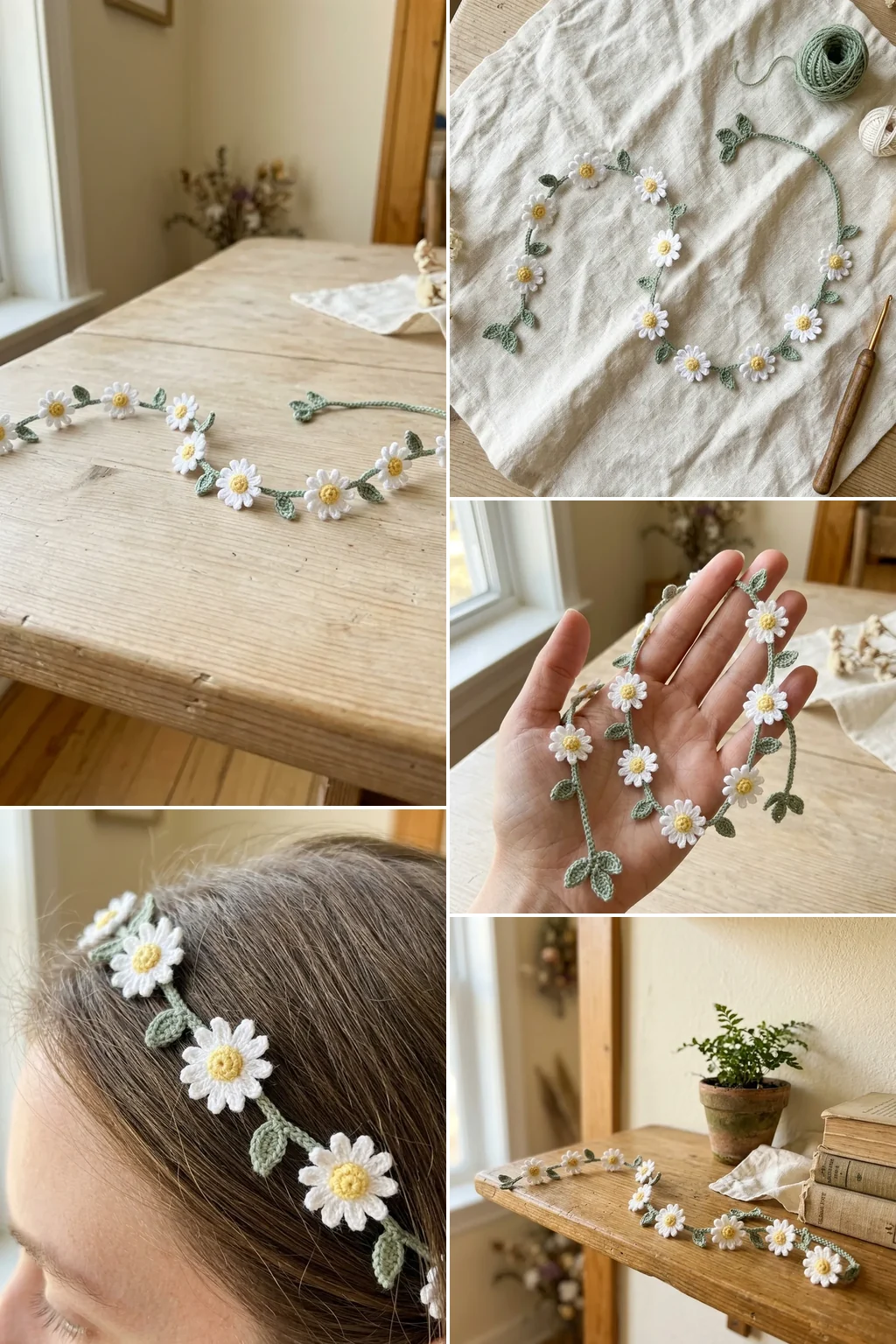
A hair vine is a length of crocheted flowers and leaves that threads through a braid or pins along the back of an updo. It uses almost no yarn, it takes an evening, and it is one of the few crochet pieces that photographs better worn than flat.
It is also a project with one structural secret. A vine made of crochet alone goes limp and slides out of the hair within an hour. A fine floral wire woven through the last row turns the same piece into something that holds whatever shape you bend it into, and that single addition is the difference between an accessory and a tangle.
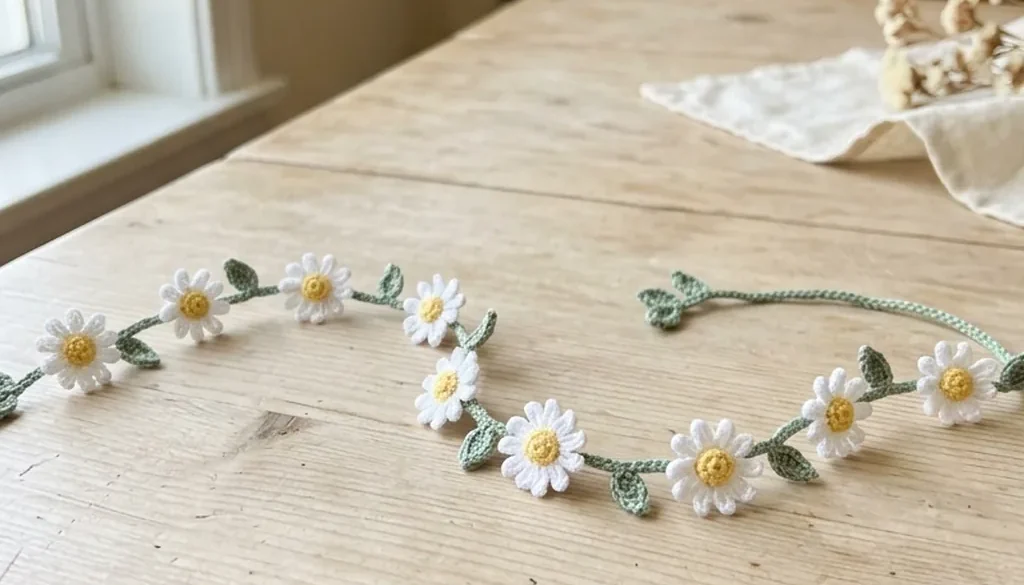
This is the daisy meadow hair vine crochet pattern written as a construction guide: the daisy, the leaves, the vine that joins them, the wire, and how to get it to stay in actual hair.
Daisy Meadow Hair Vine at a Glance
| Skill level | Confident beginner — small motifs, fine hook |
| Yarn | Fine cotton thread or embroidery floss |
| Hook | 2.0–2.5 mm |
| Time | 4–6 hours |
| Yarn used | Under 60 yards in total |
| Essential | Fine floral wire — not optional |
Materials
- White or cream cotton thread — 25 yards for the petals.
- Soft yellow — 10 yards for the centres.
- Sage or moss green — 25 yards for the leaves and the vine.
- 2.0–2.5 mm hook. Finer than feels comfortable. A daisy worked on a 4 mm hook is the size of a coaster and sits on the head like a badge.
- Fine floral wire, 26 or 28 gauge. The thinnest you can find that still holds a bend.
- Bobby pins, or two small metal hair combs.
- Tapestry needle and sharp scissors.
Cotton thread rather than yarn. Thread holds the daisy’s shape, takes a tight centre, and keeps the whole piece light enough that it does not drag on the hair. Embroidery floss works too and comes in more colours; split it to three strands rather than using all six.
Choosing the Thread
Three decisions, and the first one matters more than the other two.
Weight. Size 10 crochet cotton is the sweet spot: fine enough that a nine-petal daisy comes out under an inch, sturdy enough that the petals hold their shape without stiffening. Size 20 gives a more delicate flower and takes noticeably longer. DK yarn is too heavy for anything worn in hair — it makes a flower that reads as a brooch.
Finish. Matte cotton over mercerised. Mercerised thread has a sheen that catches light unevenly across a curved petal and photographs with hot spots. Matte reads closer to a real flower.
Colour. Pure white is the obvious choice and the harder one to wear — against most hair it reads as very bright. Ivory or a warm off-white sits better on everyone and still reads as a daisy. For the centres, a soft buttery yellow rather than a saturated one: bright yellow at this scale draws the eye to nine small dots rather than to the flowers.
Green is the colour people get wrong most often. A true grass green fights the hair; sage, moss or a greyed olive recedes and lets the daisies carry the piece.
Length: Measure the Hair, Not the Head
A hair vine is sized to the hair it goes into, which is the measurement most people skip.
Measure the length of the hair and subtract about three inches. A vine that runs the full length reaches past the end of a braid and hangs loose; three inches short finishes inside the hair where the last flower has something to grip.
| Style | Vine length | Daisies | Leaves | Time |
|---|---|---|---|---|
| Half-up / crown | 10 in | 5 | 8 | 3 hrs |
| Shoulder-length braid | 14 in | 7 | 12 | 4 hrs |
| Long braid | 20 in | 9 | 16 | 5 hrs |
| Full-length, waist braid | 28 in | 13 | 22 | 6 hrs |
Odd numbers of daisies. An even run reads as a repeat and the eye starts looking for the pattern; an odd one reads as scattered.
The Daisy
Two parts: a tight yellow centre worked in the round, and petals worked off it one at a time.
The centre
- Magic ring in yellow. A magic ring rather than a chain ring, because a chain leaves a hole in the middle of the flower and the centre of a daisy has to be solid.
- Work 6 single crochet into the ring and pull it closed.
- Round 2: 2 single crochet into each stitch. (12)
- Round 3: alternate 1 single crochet and 2 single crochet into the next. (18)
- Join to the first stitch. Switch to white before pulling the final loop through — changing colour on the join rather than after it keeps the boundary clean.
The petals
Each petal is a chain worked back along itself, anchored to the centre.
- Chain 10.
- Single crochet into the second chain from the hook.
- Half double crochet into the next chain.
- Single crochet into each remaining chain back to the centre.
- Skip one stitch on the yellow centre and slip stitch into the next.
- Repeat all the way round.
Skipping one stitch between petals on an 18-stitch centre gives nine petals, which is the count that reads as a daisy. The half double crochet near the tip is what makes the petal slightly wider at the end instead of a straight spike.
Leave a long tail when you fasten off. That tail sews the daisy to the vine, and cutting it short means threading a new one later.
Ten to fifteen minutes each once the rhythm is there. The same construction appears at a larger scale on a sunshine daisy baby dress, where the flower is set into a granny square rather than left free.
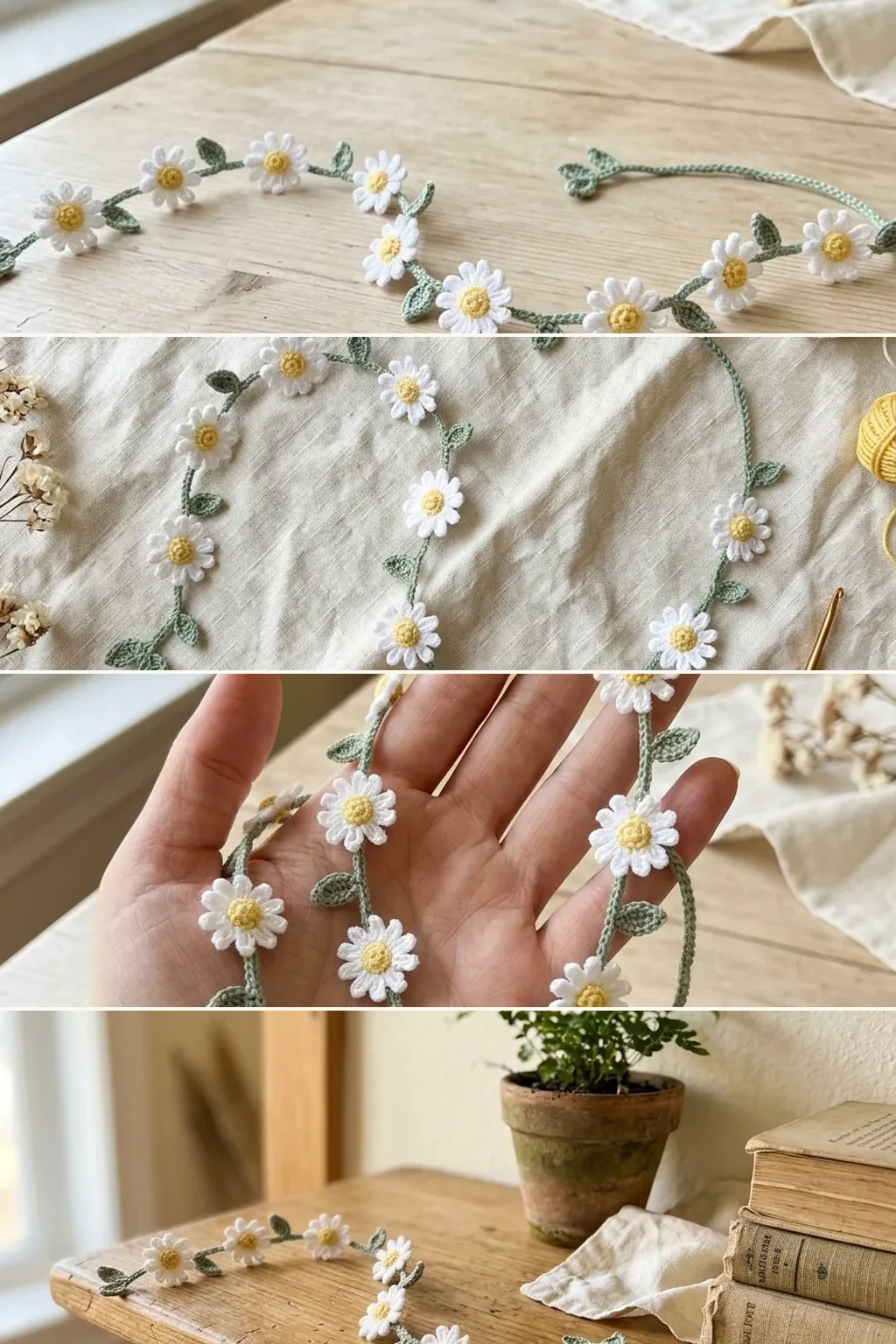
Changing the size
Hook size does all the work. The same instructions on a 2.0 mm hook in fine thread give a daisy under an inch across; on a 3.5 mm in DK they give one closer to two and a half inches. Nothing in the pattern changes.
For a hair vine, aim for three quarters of an inch to an inch and a quarter. Larger and the vine stops looking like flowers in hair and starts looking like a hat.
Vary the sizes slightly across one vine. Three sizes mixed — a few small, mostly medium, two larger — reads far more naturally than a dozen identical flowers.
The Leaves
A leaf is a chain worked back along itself, like a petal but pointed at both ends.
- Chain 8 in green.
- Starting in the second chain from the hook: slip stitch, single crochet, half double crochet, double crochet, half double crochet, single crochet, slip stitch.
- Chain 1 and turn at the tip, then work the same sequence back along the other side of the foundation chain.
- Slip stitch to join at the base and fasten off, leaving a tail.
Graduating the stitch heights from slip stitch up to double crochet and back down is what gives the leaf its taper. All single crochet gives you a green oval.
Make roughly twice as many leaves as daisies. Leaves fill the gaps, and a vine with too few looks like flowers on a string.
The double leaf
A double leaf is two leaves sharing a base, and it is what stops a vine looking like a single file of identical shapes.
Work one leaf as above but do not fasten off. Chain 3 from the base, then work a second leaf off that chain, slightly shorter — a 6-chain foundation rather than 8. Slip stitch back down to the shared base and fasten off there.
The second leaf should sit at an angle to the first rather than mirroring it. Two leaves at the same angle read as a bow; offset, they read as a sprig. Use three or four double leaves across a long vine and plain single leaves everywhere else.
Building the Vine
The vine is a long chain with the motifs worked in as you go, rather than a bare chain with everything sewn on afterward.
- Chain 10 to 15 in green.
- Work a leaf off the chain, then rejoin and chain another 10 to 15.
- Work a flower loop — chain 6 and slip stitch back into the chain to make a small ring — where a daisy will sit.
- Continue alternating: chain, leaf, chain, flower loop, chain, double leaf.
- Carry on to the length from the table, finishing on a leaf rather than a loop.
Vary the spacing deliberately. An even gap everywhere reads as manufactured; clustering two leaves together in one place and leaving a longer bare run elsewhere reads as something that grew.
Sew the daisies onto the flower loops at the end, using the long tails, stitching through the loop and the back of the yellow centre. Attaching them last means you can lay the whole vine out and move a flower before anything is permanent.
The Wire Core
This is the step that makes it work, and it takes five minutes.
Weave fine floral wire through the last row of the chain vine, running the full length. Thread it in and out of the chain stitches every half inch or so, keeping it on the back face so it does not show between the leaves.
A crocheted chain has no memory. Worn without wire, a vine straightens out, slides down the braid and works its way free. With a wire core it holds any curve you bend it to and stays where it is put.
Leave about an inch of wire beyond each end and turn each into a small loop, twisting the tail back on itself. Those loops are what the bobby pins go through. Tuck the twisted ends inward so no cut wire faces the scalp.
Over-twisting the wire slightly where it runs between motifs gives a soft crinkle rather than a hard straight line, which suits a vine better than a perfectly smooth one.
Getting It to Stay In
Two methods, and they suit different hair.
Bobby pins through the end loops. The simplest, and what most wire vines use. A pin through each end loop and one or two through the vine where it passes a dense section of braid. Best on braided or textured hair that gives a pin something to bite.
Two small combs. Sew a metal comb to the back of the vine about two inches in from each end, teeth pointing inward toward each other. The opposing angle is what locks it — combs facing the same way slide out together. Best on fine or straight hair where pins have nothing to grip.
Either way, bend the vine to shape against the head before the final fitting, not while wearing it. Wire bent in place pulls hair, and the shape you want is the one it holds when nobody is touching it.
12 Daisy Meadow Hair Vine Ideas
1. Classic White and Sage
The version above. White petals, yellow centres, sage leaves, nine daisies on a twenty-inch vine.
Mix three flower sizes rather than making them all identical. A uniform run reads as plastic.
Confident beginner · 5 hours · 60 yds
2. Bridal Ivory
Ivory petals with pale gold centres and no green at all — the leaves worked in the same ivory.
Add a few tiny pearl beads at the centres. Sew them on after the daisy is finished, never before.
Confident beginner · 5 hours · 60 yds
3. Single Crown Piece
A short ten-inch vine for a half-up style, sitting across the back of the crown.
Use a comb at each end rather than pins. A short vine has less length to anchor with.
Confident beginner · 3 hours · 35 yds
4. Wildflower Mix
Daisies alternating with tiny five-petal flowers in blush and buttercup.
Keep the daisies the largest. Equal-sized mixed flowers lose the meadow effect entirely.
Confident beginner · 6 hours · 70 yds
5. Autumn Version
Rust and gold leaves with cream daisies, for an October wedding or a photo shoot.
Double the leaf count and halve the flowers. Autumn reads through foliage, not blooms.
Confident beginner · 5 hours · 60 yds
6. Child’s Flower Crown
A fourteen-inch vine joined into a circle, sized to a child’s head rather than their hair.
Skip the wire ends and loops entirely — bind the join with thread. No cut wire anywhere near a child.
Confident beginner · 4 hours · 45 yds
7. Double Vine
Two vines pinned side by side down a thick braid, offset so the flowers alternate.
Make the second vine two inches shorter. Equal lengths sit directly on top of each other.
Confident beginner · 8 hours · 110 yds
8. Minimal Three-Daisy Pin
Three daisies and four leaves on a short wired stem, worn as a single hair pin.
The fastest version of this project, and the one most likely to get worn on an ordinary day.
Beginner · 1 hour · 15 yds
9. Trailing Length
A twenty-eight-inch vine for waist-length hair, with the flowers thinning toward the end.
Weight the top. A vine evenly covered along its whole length looks heavy at the bottom when worn.
Confident beginner · 6 hours · 80 yds
10. Matching Daisy Earrings
Two single daisies on earring hooks, made from the leftovers in twenty minutes.
Stiffen them lightly so they hang flat rather than curling forward.
Beginner · 20 min · 5 yds
11. Daisy Headband
The vine sewn along a plain fabric headband instead of wired, for everyday wear.
No wire needed here — the headband provides the structure the wire otherwise would.
Beginner · 4 hours · 50 yds
12. Gift Set with a Pin
A full vine plus the three-daisy pin from idea eight, boxed together.
Make the pin from the offcuts of the vine so the two obviously belong together.
Confident beginner · 6 hours · 75 yds
Common Problems and Fixes
The vine goes limp and slides out
No wire, or wire too thin to hold a bend. A crocheted chain has no memory at all. Weave 26 or 28 gauge floral wire through the last row.
The daisy centre has a hole in it
A chain ring was used instead of a magic ring. Only a magic ring closes completely, and on a flower this small the hole is the first thing anyone sees.
The petals curl forward
The chain was worked too tightly, so the return row pulls it into a curve. Work the chain loosely and the single crochet back along it at normal tension.
The flowers all look the same
They are the same. Vary the hook by a quarter millimetre across a few of them, or vary the petal chain between 9 and 11. Small differences are what read as natural.
The vine is too long when worn
Measured against the head rather than the hair. It should finish about three inches short of the end of the braid, inside the hair.
The wire ends catch in the hair
The end loops were not turned inward. Twist each tail back on itself and tuck the cut end into the crochet so nothing sharp faces outward.
It will not stay in fine hair
Bobby pins need texture to grip. Switch to two small combs set two inches in from each end with the teeth facing inward toward each other.
Keeping It
Do not wash a wired hair vine. Spot clean the flowers with a damp cloth and let them air dry flat — water through the whole piece rusts the wire and leaves a mark that cannot be removed.
Store it flat in a shallow box rather than coiled. Crochet recovers from being squashed; wire keeps whatever shape it was left in for months.
Reshape it before each wearing by bending the wire gently along its length. That takes thirty seconds and makes a vine that has been in a drawer look new.
If the thread flattens, a very brief hold over steam lifts the petals again. Keep the wire out of the steam.
Frequently Asked Questions
How much yarn does a hair vine take?
Under 60 yards in total across all three colours for a twenty-inch vine. It is a genuine scrap project.
How long should the vine be?
Measure the hair and subtract about three inches, so the last flower finishes inside the braid rather than past the end of it.
Do I really need the wire?
Yes. Crochet has no memory, and without a wire core the vine straightens, slides down and falls out. It is the one component that cannot be left out.
What hook size should I use?
2.0 to 2.5 mm with fine cotton thread. The same instructions on a larger hook give a much larger daisy — hook size is the only thing that sets the flower size.
Why a magic ring for the centre?
It closes completely. A chain ring leaves a hole in the middle of the flower, and on a daisy under an inch across that hole is the first thing anyone notices.
How many petals should a daisy have?
Nine, from an 18-stitch centre with one stitch skipped between each. Fewer reads as a generic flower and more crowds the centre.
Bobby pins or combs?
Pins for braided or textured hair, combs for fine or straight hair. Set combs about two inches in from each end with the teeth facing inward.
Can I wash it?
No. Spot clean the flowers only — soaking the whole piece rusts the wire and stains the thread around it.
Can a beginner make this?
Yes, with patience for the small hook. Every stitch is basic; the challenge is scale rather than technique.
How long does one take?
Four to six hours. The daisies are ten to fifteen minutes each and the vine itself goes quickly.
Final Thoughts
Make one daisy first and hold it against the head before making eleven more. Scale is the thing that goes wrong on this project, and a flower that looks charming on the table can look like a brooch once it is in hair.
Then wire it before deciding it does not work. A finished vine without a wire core looks like a failure and is twenty minutes from being the thing you wanted — the same way a small sewn motif only sits right once it is anchored properly, as on a pair of mint clover baby booties.