 Clara•🕑 October 7, 2026•💬 No comments
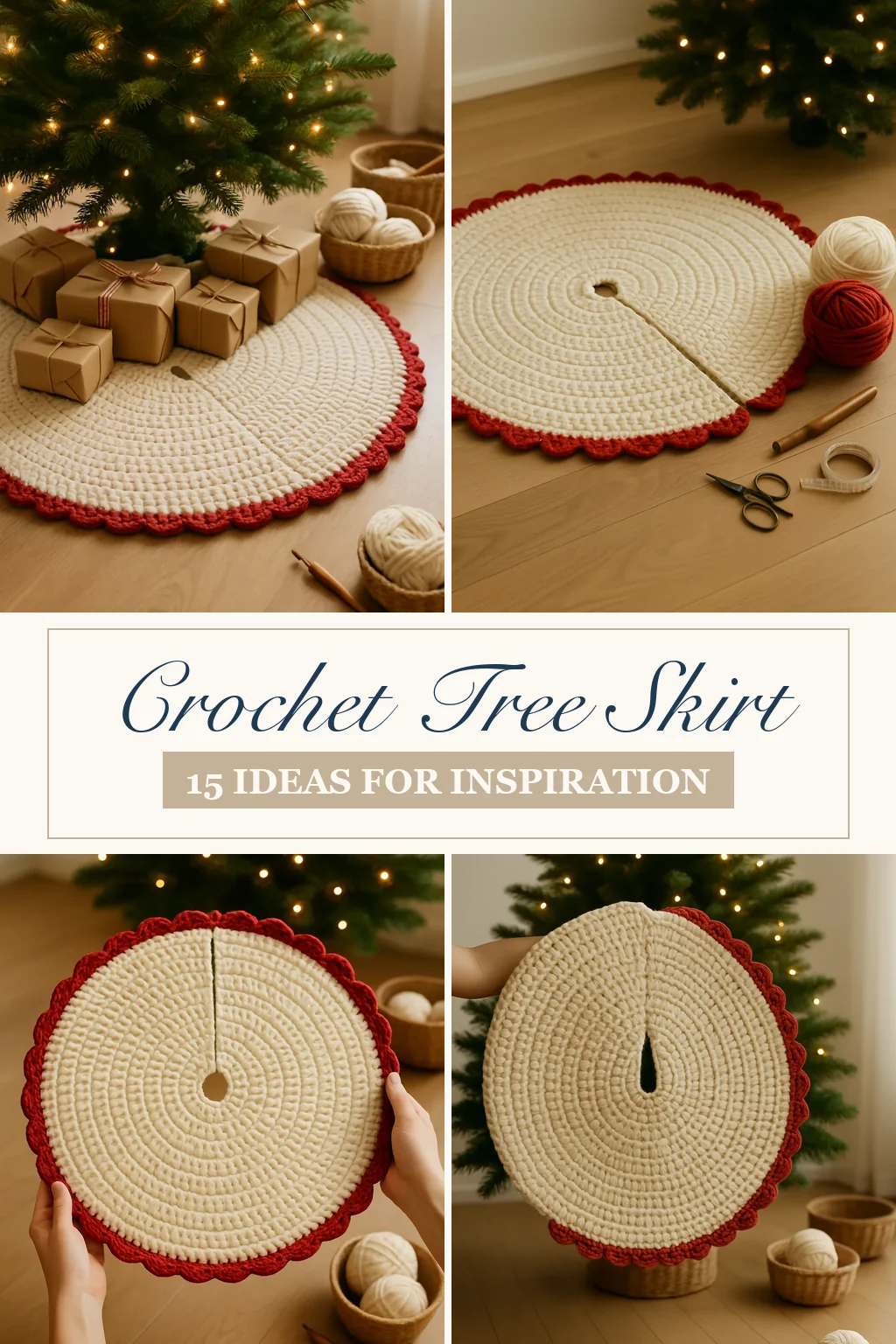
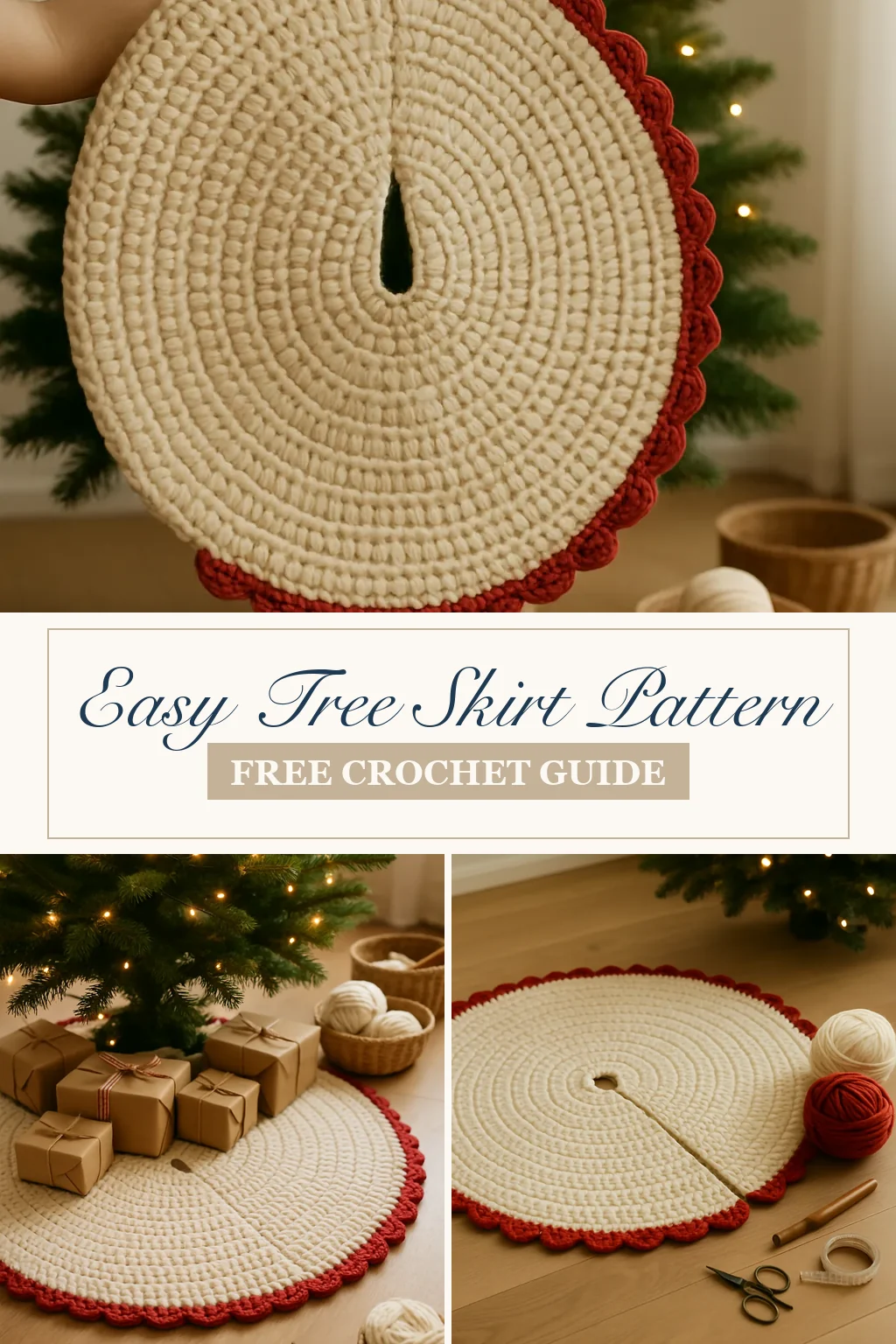
A crochet Christmas tree skirt is a large flat circle with a slit in it, which makes it one of the few Christmas projects where the technique asks almost nothing of you and the only real risk is getting the maths wrong. A skirt that ruffles at the edge or cups in the middle is not a stitch problem — it is an increase problem, and the rule that prevents it fits in one sentence. This guide covers that rule, the sizes that suit real trees, and 15 tree skirt ideas.
Crochet Tree Skirts at a Glance
- Skill level: beginner — one stitch, worked in rounds
- Time: 8–14 hours depending on size and yarn weight
- Yarn:
900–1,800 yardsof chunky or worsted acrylic - Hook:
6.5 mmfor chunky,5.5 mmfor worsted - Finished size:
36–48 in/90–120 cmacross - Start by: late October — it is the largest Christmas crochet project
Sizing a Skirt to Your Tree
The skirt should reach just past the widest branches, so the stand disappears but the skirt does not swallow the floor around it.
| Tree height | Skirt diameter | Centre hole | Yarn (chunky) |
|---|---|---|---|
| 4 ft / 120 cm | 30 in / 76 cm | 4 in / 10 cm | 650 yds |
| 6 ft / 180 cm | 36 in / 91 cm | 5 in / 13 cm | 950 yds |
| 7 ft / 210 cm | 42 in / 107 cm | 5 in / 13 cm | 1,300 yds |
| 8 ft / 240 cm | 48 in / 122 cm | 6 in / 15 cm | 1,750 yds |
Measure your stand, not your tree. The centre hole has to clear the trunk and the stand’s central column — usually 4 to 6 inches. Too small and the skirt will not sit flat around the base; too large and the stand shows through.
Choosing Yarn
This is a large flat piece that sits on the floor and gets walked past, nudged and occasionally trodden on for six weeks a year.
Chunky acrylic is the sensible default. It works up fast, which matters across 1,000+ yards, it holds its shape flat, and it survives being vacuumed around. Wool is lovely and expensive for something that spends most of its life in a box. Cotton is heavy at this size and stretches out of round under its own weight.
| Yarn | Hours | Lies flat | Verdict |
|---|---|---|---|
| Chunky acrylic (5) | 8–10 | Yes | Use this |
| Worsted acrylic (4) | 12–14 | Yes | Finer detail, slower |
| Cotton | 14–16 | Stretches | Avoid at this size |
| Wool blend | 10–12 | Yes | Beautiful, costly |
| Chenille / velvet | 8–10 | Yes | Hides stitches, very soft |
The Flat Circle Rule
Everything about a tree skirt comes down to this, and it is the part people get wrong.
However many stitches you put in round 1 is how many you add in every round after. Start with 12 double crochet, add 12 every round. Start with 6 single crochet, add 6 every round. That is the whole formula, and it holds for half double and treble too.
| Stitch | Round 1 | Increase per round | Round 5 total |
|---|---|---|---|
| Single crochet | 6 | +6 | 30 |
| Half double crochet | 8 | +8 | 40 |
| Double crochet | 12 | +12 | 60 |
| Treble crochet | 16 | +16 | 80 |
How the increases are spaced
The increases move one stitch further apart each round, which is what spreads them evenly:
- Round 2: 2 stitches in every stitch.
- Round 3: 2 in the first, 1 in the next. Repeat.
- Round 4: 2 in the first, 1 in each of the next 2. Repeat.
- Round 5: 2 in the first, 1 in each of the next 3. Repeat.
Continue the pattern — each round the plain stitches between increases grow by one.
Stagger the increases or you get a hexagon
If every increase sits directly above the one below, the circle develops visible corners and comes out as a soft hexagon. Shift where the increases fall from round to round — start round 4 with two plain stitches before the first increase, for instance. The increase count stays the same; only the position moves.
Making the Skirt
Starting
- Make a magic ring. Chain 3, which counts as your first double crochet.
- Work 11 more double crochet into the ring, for 12 total. Pull the ring closed.
- Slip stitch into the top of the chain-3 to join.
A magic ring rather than a chain ring matters here: the centre hole gets cut open later anyway, but a loose chain ring makes the first rounds sag and that distortion carries outward through the whole skirt.
Working outward
- Chain 3, then follow the increase pattern above for each round.
- Join each round with a slip stitch into the top of the starting chain-3.
- Continue until the circle measures your target diameter. For a 36 inch skirt in chunky yarn that is roughly 22 rounds.
Measure across the middle every five rounds. A circle grows faster than people expect, and it is far easier to stop at the right round than to unravel four rounds of 200+ stitches.
The opening
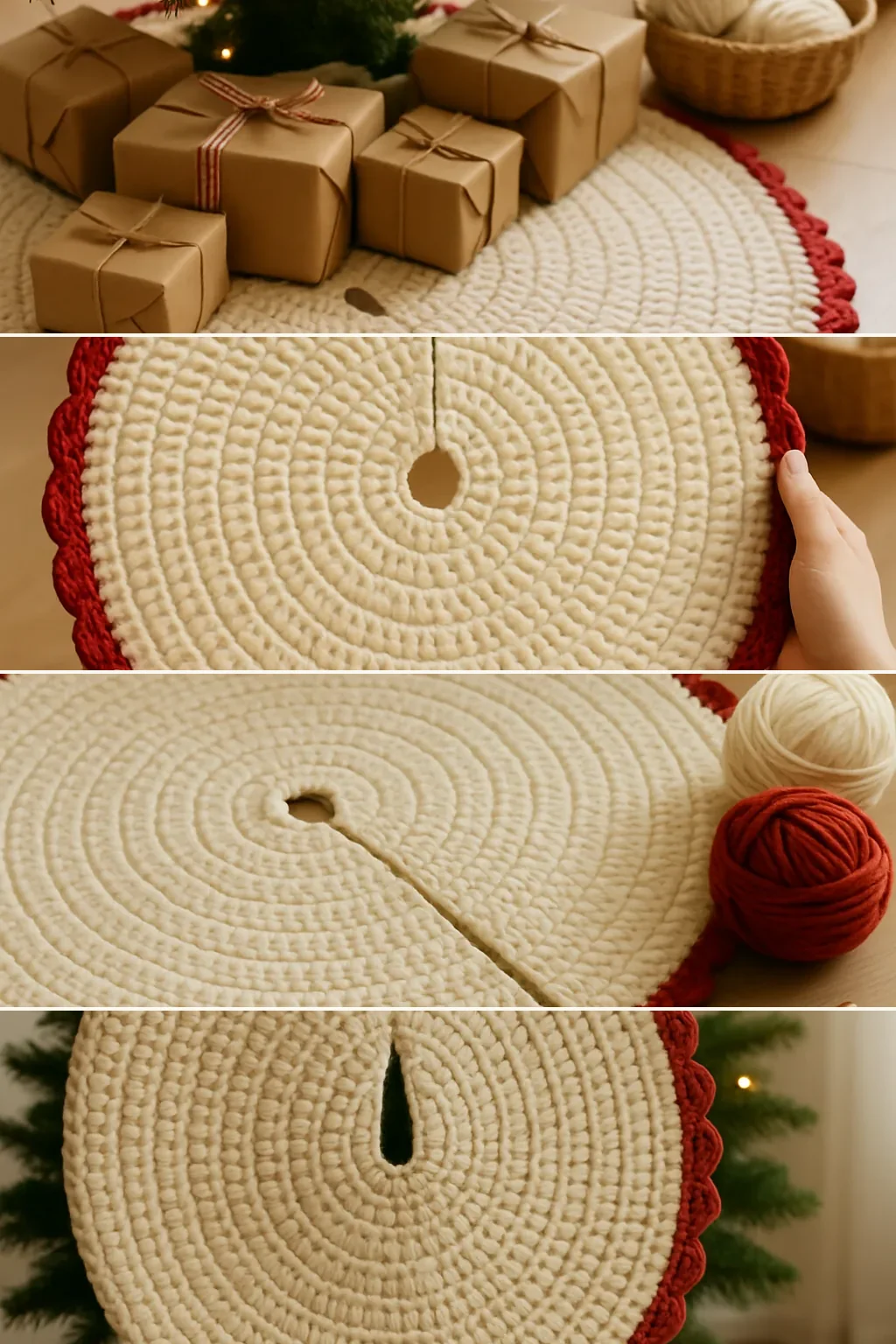
The slit lets the skirt go around the trunk.
- Decide where the back is and mark a straight line from the centre to the edge.
- Cut the centre hole to your measured diameter, then cut outward along the marked line.
- Work a round of single crochet all the way around every raw edge — the outer edge, both sides of the slit and the centre hole.
That border round is structural, not decorative. Cut crochet unravels, and the single crochet round is what locks the cut stitches permanently.
Ties
Make two chains of about 30 stitches and attach them either side of the slit, roughly a third of the way out from the centre. Ties at the very edge pull the slit open rather than closed.
Common Problems and Fixes
The edge ruffles and waves
Too many stitches — you increased more than your round 1 count somewhere, or your tension loosened. Count one round carefully against the formula. If the count is right, go down a hook size.
The circle cups upward like a bowl
Too few stitches, or tension too tight. Add the missing increases in the next round, or go up a hook size. A slight cup in the first three rounds often flattens by round eight; a cup still present at round ten will not resolve on its own.
It came out as a hexagon
Increases stacked above each other. Stagger their position from round to round. This cannot be corrected retrospectively — the corners are worked into the fabric — so check by round four.
There is a visible seam up one side
The chain-3 at the start of each round creates a slight jog. Working in a continuous spiral instead of joined rounds removes it, at the cost of making the round count harder to track. Alternatively, put the seam at the back where the slit is.
It will not lie flat on the floor
Block it. A large acrylic piece holds whatever shape it was stored in, and a skirt folded in a box for eleven months needs steam held above it — never an iron pressed on — to relax back to flat.
Working Out Rounds and Yarn for Any Size
The chart covers standard trees. For anything else, measure rather than guess — this is a big enough project that a wrong estimate costs several balls.
Rounds to diameter
Each round adds roughly twice the height of one stitch to the diameter, because the circle grows from both sides at once. In chunky double crochet that is about 1.6 in per round.
- Work five rounds and measure the diameter across the middle.
- Divide by 5 to get your growth per round.
- Divide your target diameter by that figure for the total round count.
Measure across the middle, not corner to corner, and measure the same axis each time — an early circle is rarely perfectly round and different axes give different answers.
Yarn by area
- Work a
4 x 4 inswatch in your stitch and yarn. - Unravel it and measure the yarn used — say 30 yards.
- That is about
1.9 yards per square inch. - A 36 inch circle has an area of about 1,020 square inches, so roughly 1,900 yards.
- Subtract the centre hole, add 10% for the border and ties.
| Diameter | Area | Chunky | Worsted |
|---|---|---|---|
| 18 in / 46 cm | 254 sq in | 300 yds | 420 yds |
| 30 in / 76 cm | 707 sq in | 650 yds | 900 yds |
| 36 in / 91 cm | 1,018 sq in | 950 yds | 1,300 yds |
| 42 in / 107 cm | 1,385 sq in | 1,300 yds | 1,750 yds |
| 48 in / 122 cm | 1,810 sq in | 1,750 yds | 2,300 yds |
Buy it all at once and check the dye lots match. A dye lot change shows as a visible ring on a concentric piece, far more obviously than on a blanket worked in rows.
Finishing Touches That Matter
Weight the edge if it curls
A large acrylic circle can lift at the edge on a carpeted floor. Working the final round in a slightly heavier yarn, or threading a length of chain through the border round, settles it without showing.
Match the skirt to the stockings
If you have crocheted stockings for the mantel, repeat one element — the cuff colour, the border stitch, a motif — on the skirt. A single repeated detail ties the room together more effectively than matching everything exactly.
Add a pocket for the lights plug
A small crocheted pocket on the underside near the slit holds the plug and the trailing cable tidily. Ten minutes of work, and it solves the one practical annoyance of a floor-level tree base.
Make the ties long enough
Thirty chains sounds generous and is about right once the skirt is around a stand with a cable running under it. Short ties pull the slit open rather than closing it, which is the opposite of their job.
15 Crochet Christmas Tree Skirt Ideas
Each gives difficulty, time and yarn.
1. Classic Cream With Red Edging
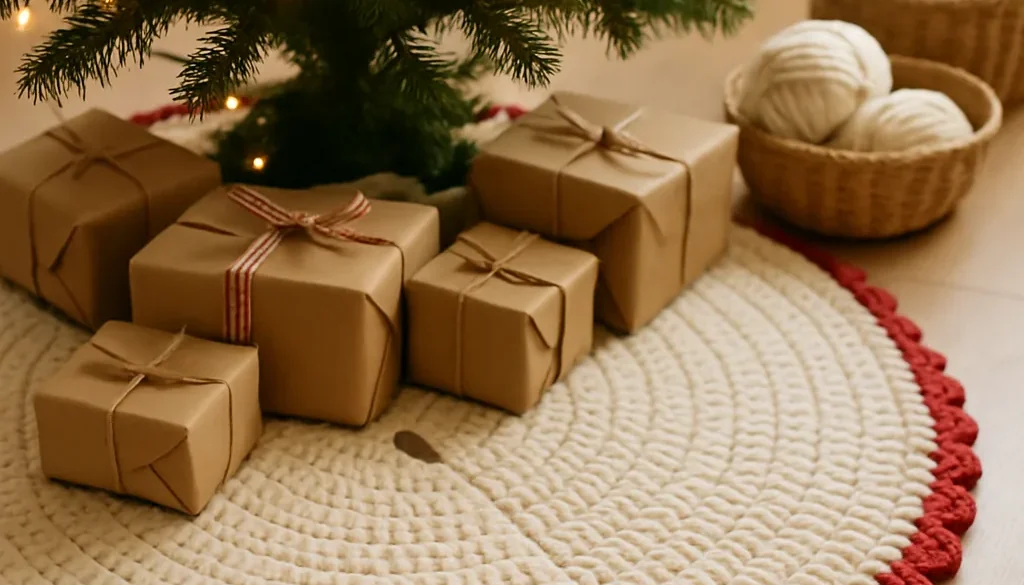
Plain double crochet rounds in cream with three rounds of red at the edge. The simplest version and the one that suits the widest range of tree decorations.
Work the red rounds without increases. The edging reads as a deliberate band rather than part of the circle, and skipping increases pulls it in slightly so it sits flat against the floor.
Beginner · 9 hours · 950 yds
2. Scalloped Edge Skirt
A plain body finished with a shell border. The scallops add about two inches to the diameter, so stop the body two inches short of your target.
Work shells over a multiple of six stitches. Your final round count will rarely divide by six exactly, so adjust on the round before by adding or skipping a stitch or two.
Beginner · 10 hours · 1,000 yds
3. Concentric Colour Rings
Bands of red, cream and green working outward. Change colour at the back where the slit is, so every join is hidden in the opening.
Keep each band an odd number of rounds. Even bands put the same colour at both the inner and outer edge of the skirt, which reads as a miscount.
Beginner · 10 hours · 1,000 yds
4. Granny Stitch Skirt
Clusters and chain spaces worked in the round. Faster than solid stitches and lighter on yarn, though small ornaments can fall through the gaps.
Place a plain backing circle underneath if small ornaments tend to end up on the floor. The granny gaps are large enough to swallow a bauble hook.
Beginner · 7 hours · 800 yds
5. Chunky Velvet Skirt
Velvet yarn in a single deep colour. The yarn does all the work, which suits a skirt where stitch detail is mostly hidden under presents anyway.
Work tighter than feels natural, at 6.0 mm rather than 6.5. Velvet yarn worms badly over a large flat piece, and a firm fabric holds the pile in place.
Beginner · 8 hours · 1,100 yds
6. Snowflake Appliqué Skirt
A plain cream base with crocheted snowflakes sewn across it. Make the snowflakes in spare moments and attach them all at the end in one sitting.
Stiffen the snowflakes before sewing them on. A soft appliqué flattens into a shapeless patch within a week of presents being piled on it.
Intermediate · 14 hours · 1,050 yds
7. Hexagon Patchwork Skirt
Joined hexagons rather than a worked circle. The hexagon shape that ruins a plain skirt becomes the design here, and it is entirely portable work.
Make one hexagon and measure it before making forty. The finished diameter is the hexagon width times the number across, and that arithmetic is much cheaper done early.
Intermediate · 15 hours · 1,100 yds
8. Faux Fur Edged Skirt
A plain body with three rounds of fur-effect yarn at the edge. Work the fur rounds on a larger hook, because the pile makes the stitches almost impossible to see into.
Count the base round stitches before switching to fur. Once the pile is on you cannot see the stitches to recount, and a miscount at that stage means unpicking fur yarn.
Beginner · 9 hours · 1,000 yds
9. Ripple Edge Skirt
The outer six rounds worked as a chevron so the edge zigzags. No border round needed, since the ripple edge is already a finished shape.
Your final round must divide by the ripple repeat, usually 12 or 14. Plan the last plain round’s count around that number rather than discovering the mismatch at the end.
Intermediate · 11 hours · 1,050 yds
10. Mini Skirt for a Tabletop Tree
Eighteen inches across for a small tree. Three hours of work, and the best way to test the increase rule before committing to a full-size skirt.
Use worsted rather than chunky at this size. Chunky stitches are too large relative to an 18 inch circle and the increases show as obvious spokes.
Beginner · 3 hours · 300 yds
11. Two-Sided Reversible Skirt
Two circles crocheted separately and joined back to back, one red and one cream. Twice the yarn, but it changes the look of the tree base each year.
Make both circles to the same round count, then block them together before joining. Two circles that differ by half an inch will not lie flat once seamed.
Intermediate · 18 hours · 1,900 yds
12. Star Point Skirt
Increases concentrated at eight points so the skirt forms a star rather than a circle. The hexagon mistake taken deliberately much further.
Put all the increases at eight fixed points and none between them. This is the hexagon mistake used on purpose, so the increases must stack rather than stagger.
Advanced · 13 hours · 1,100 yds
13. Textured Bobble Skirt
Bands of bobbles between plain rounds. Keep the bobbles to the outer third — under the presents they are invisible and they use noticeably more yarn.
Work bobbles on the round after an increase round, never on the increase round itself. Combining a bobble and an increase in one stitch distorts both.
Intermediate · 12 hours · 1,250 yds
14. Lace Overlay Skirt
An open filet-style pattern over a plain backing circle in a contrasting colour. The backing shows through the lace, which is where the whole effect comes from.
Make the backing circle an inch smaller than the lace layer. A backing that reaches the edge shows past the lace and spoils the overlay effect.
Advanced · 16 hours · 1,500 yds
15. Scrap Yarn Stripe Skirt
Narrow stripes of whatever is left in the stash, with one unifying colour every fourth round. The repeated colour is what turns scraps into a scheme.
Keep every scrap the same weight. Mixing worsted and chunky across rounds means the circle grows unevenly and will not lie flat however correct the stitch count is.
Beginner · 10 hours · 1,000 yds scraps
Storing It Between Years
A tree skirt spends eleven months in a box, and how it goes in decides how it looks coming out.
Roll it rather than folding it. Roll it around a cardboard tube or a rolled towel. Folded acrylic keeps its creases for months, and a creased skirt sits in ridges around the tree base.
Store it in a sealed box rather than a loose bag, and keep it out of a loft where damp and temperature swings flatten the texture. If it does come out creased, steam held above the fabric relaxes it — pressing an iron onto acrylic flattens the stitches permanently.
Frequently Asked Questions
How big should a crochet tree skirt be?
About 36 inches across for a 6 ft tree, 42 for a 7 ft and 48 for an 8 ft. It should reach just past the widest branches so the stand is hidden.
How much yarn does a tree skirt take?
Between 650 and 1,750 yards of chunky yarn depending on diameter. A 36 inch skirt needs roughly 950 yards, so buy all the yarn in one dye lot.
Why does my crochet circle ruffle?
Too many stitches, or tension that is too loose. Count a round against the formula — however many stitches you started with is how many you add each round — and go down a hook size if the count is correct.
Why is my circle turning into a hexagon?
The increases are stacking directly above each other. Shift their position each round so they do not align. This cannot be fixed later, so check by round four.
How many stitches do I start with?
12 double crochet in a magic ring, then add 12 every round. For single crochet start with 6 and add 6, and for half double start with 8 and add 8.
Do I cut the slit or crochet it?
Either works. Cutting then working a single crochet round over every raw edge is faster and gives a neater line, and that border round is what stops the cut stitches unravelling.
What is the best yarn for a tree skirt?
Chunky acrylic. It works up fast across a large piece, holds its shape flat, and survives being vacuumed around for six weeks a year.
How long does a tree skirt take?
Between 8 and 14 hours for a full-size one depending on yarn weight and stitch. A tabletop version takes about three, which makes it a good test run.
Should the rounds be joined or spiral?
Joined rounds are easier to count and the slight seam can be hidden at the back where the slit is. Spiral rounds have no seam but make tracking the round count harder on a project this size.
Final Thoughts
Make the tabletop version first. Three hours proves your increase rule works at your tension, shows whether your hook size gives a flat circle, and gives you a skirt for a small tree either way. Then scale the same formula up, measure every five rounds, and start in late October — this is the largest Christmas crochet project there is.